
Plan the investigation
What students will do
Start with a guided comparison, then plan an investigation, analyze a graph, and check a prediction.
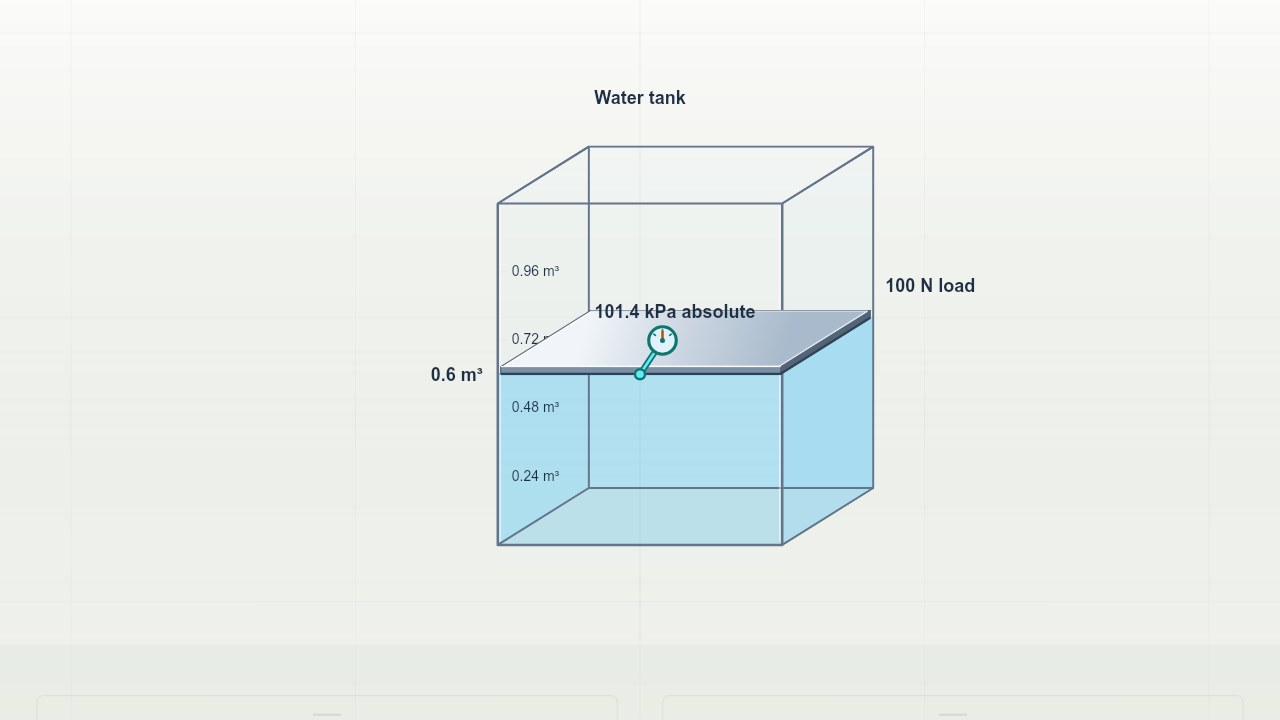
- Compare piston loads. Keep face area fixed and measure the pressure added by different downward loads.
- Design and collect. Choose at least five face areas while keeping the load and liquid settings unchanged. Read pressure from the load alone.
- Linearize the data. Choose graph quantities that form a straight line. Use slope and intercept to test the model and determine the applied load.
- Explain and predict. Evaluate the area–pressure relationship, then predict added pressure for an unused area and measure it to check.
What students will learn
- Distinguish pressure added by a load from absolute pressure.
- Test the inverse relationship between face area and pressure.
- Infer an applied load from a graph and test a new prediction.
Common misconception
Does doubling piston area double the pressure from its load?
Students isolate area while keeping the total load fixed.