Identify the conservation condition
Choose the complete system and fixed axis, then check the net external angular impulse. Distinguish a force through the axis from a torque about that axis.
 BuildPhysics
AP Physics 1 · Unit 6 · Rotating Systems
Track the same total angular momentum through changing inertia and internal interactions.
12 questions6 conceptual · 6 calculation
Start practiceFree · No account required · Self-paced
 Open interactive practice
What you’ll practice
Choose the complete system and fixed axis, then check the net external angular impulse. Distinguish a force through the axis from a torque about that axis.
Combine rotating disks, an incoming point mass, or opposite wheel and student contributions using one sign convention. Include the inertia of objects added during a sticking collision.
Predict how angular speed responds to changing inertia. Calculate orbital endpoint speeds and the work needed to start a walker and turntable from rest.
A question from this set
Two disks exchange frictional torques on a common frictionless axle. Which condition allows the total angular momentum of both disks to remain constant about that axle?
Try it in the practice setKey ideas
Friction between disks and foot contact on a turntable redistribute angular momentum inside the selected system. Individual components can change while the total remains constant.
A contracting cloud or inward-moving masses can rotate faster without an external torque. Internal work or gravitational energy can increase kinetic energy even as Iω remains constant.
See the physics
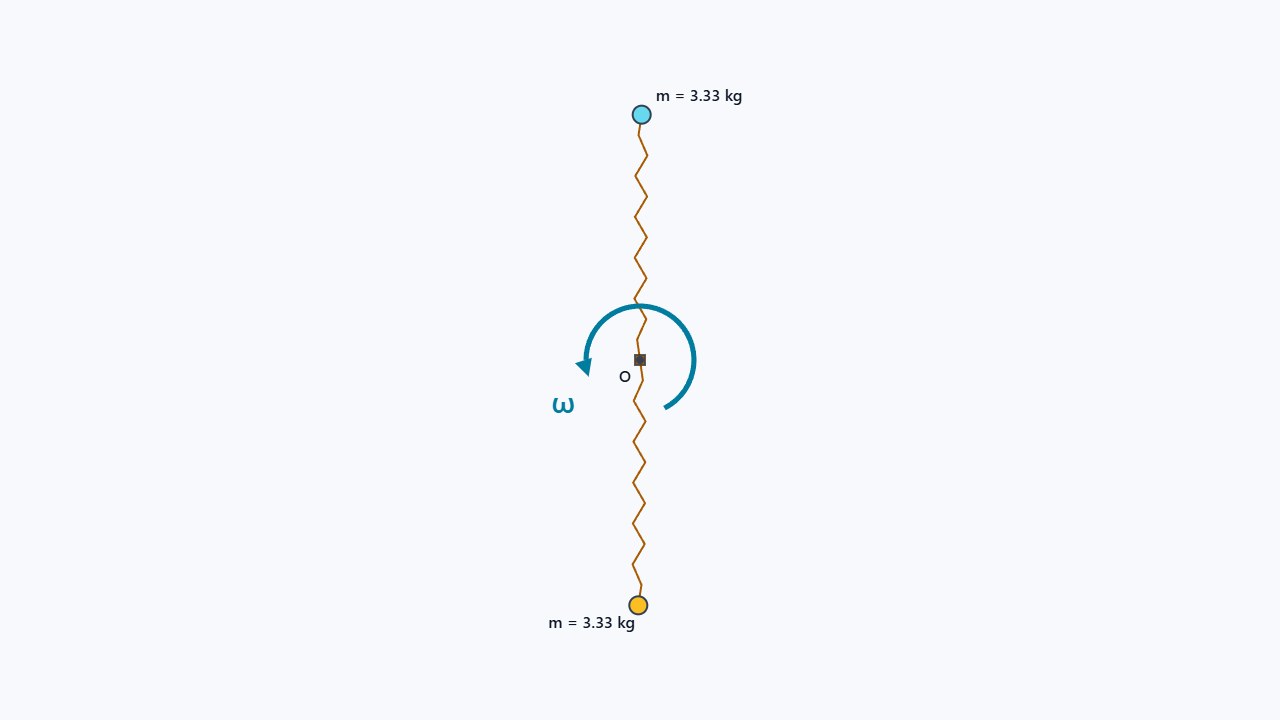
After an attempt, run the native models and compare component angular momenta with their sum. Track energy lost during synchronization or capture, energy gained during inward redistribution, and near and far orbit measurements. The wheel model displays vertical-component transfer with separately drawn axial degrees of freedom.
Use a hint for a starting point or open a worked solution to follow the reasoning. Your progress saves in this browser, so you can return to unfinished questions.
Begin with a conceptual question, then work through the calculations.