
Plan the investigation
What students will do
Start with a guided comparison, then plan an investigation, analyze a graph, and check a prediction.
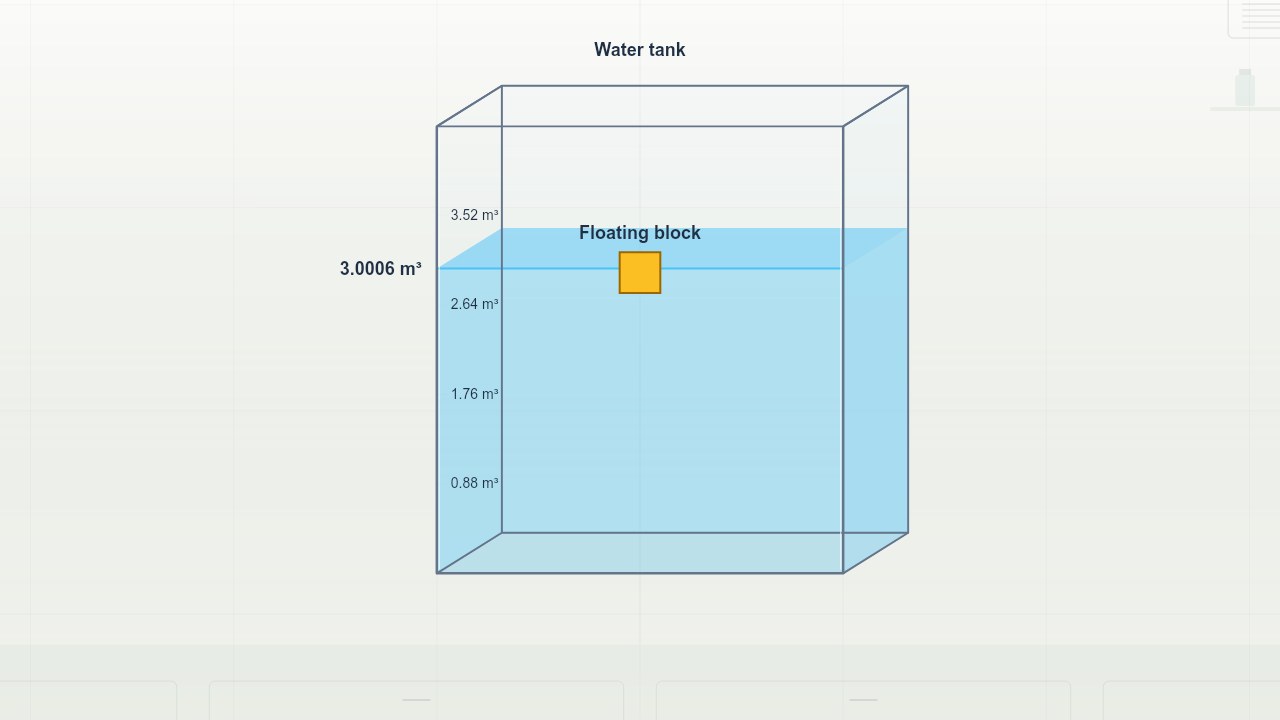
- Compare floating masses. Keep liquid density fixed and compare submerged fraction, buoyant force, and weight for different specimen masses.
- Design and collect. Choose at least five liquid densities with block mass and size fixed. Set the floating position and measure submerged fraction in each liquid.
- Linearize the data. Transform liquid density and submerged fraction to produce a straight line. Determine block density from the fitted slope.
- Explain and predict. Use force balance to evaluate floating and sinking, then predict and check submerged fraction in an unused liquid density.
What students will learn
- Explain floating equilibrium using buoyant force and weight.
- Distinguish block density from the surrounding liquid’s density.
- Infer block density from a graph and predict its floating fraction.
Common misconception
Must a floating object be completely underwater?
Only enough liquid must be displaced to balance the object’s weight.