
Plan the investigation
What students will do
Start with a guided comparison, then plan an investigation, analyze a graph, and check a prediction.
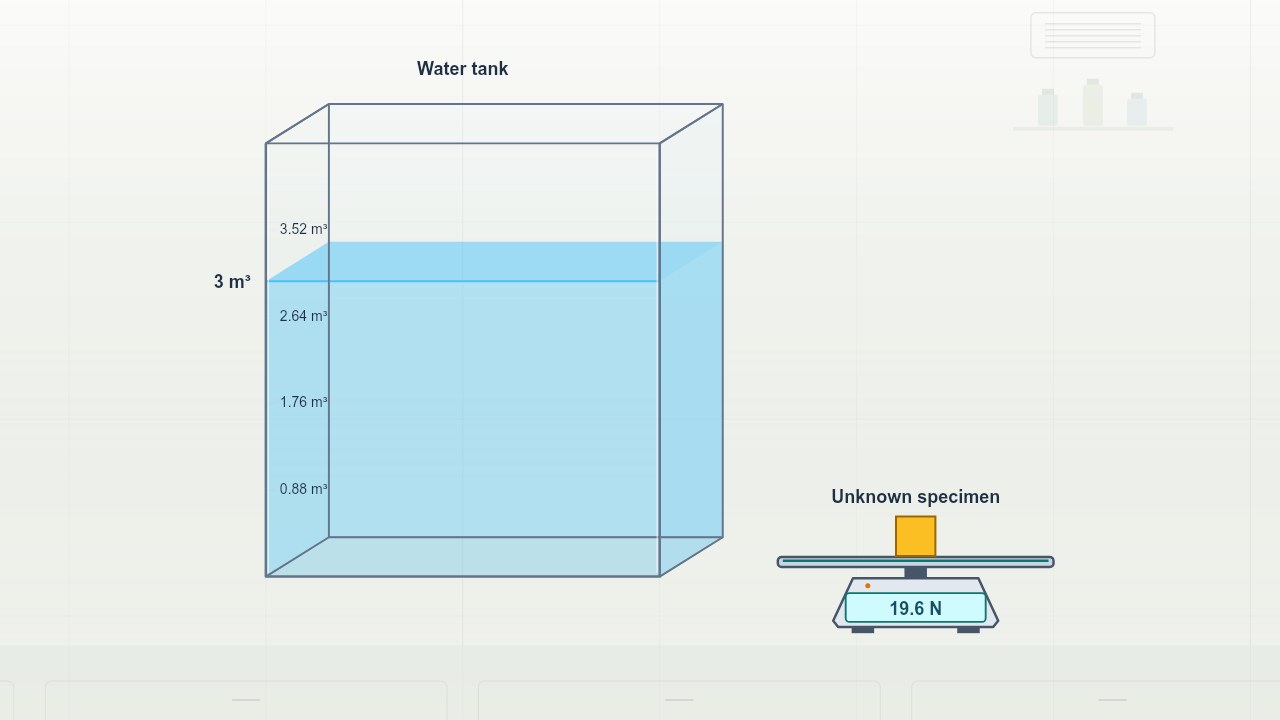
- Compare immersion positions. Measure displaced volume with the specimen partly submerged, fully submerged, and deeper underwater.
- Design and collect. Choose at least five specimen depths while keeping material density, width, and height fixed. Measure weight in air and volume displaced by full immersion.
- Analyze a graph. Calculate specimen mass from weight and fit mass versus measured displaced volume. Determine density from the best-fit slope.
- Explain and predict. Evaluate whether specimen size changes density. Use your fit to predict mass for an unused size, then weigh it to check.
What students will learn
- Identify when displaced water measures the specimen’s full volume.
- Determine material density from a mass–volume graph.
- Plan controlled measurements and test a graph-based mass prediction.
Common misconception
Must a larger specimen have a greater density?
Students compare mass and volume for different sizes of the same material.