Find pressures and nozzle speeds
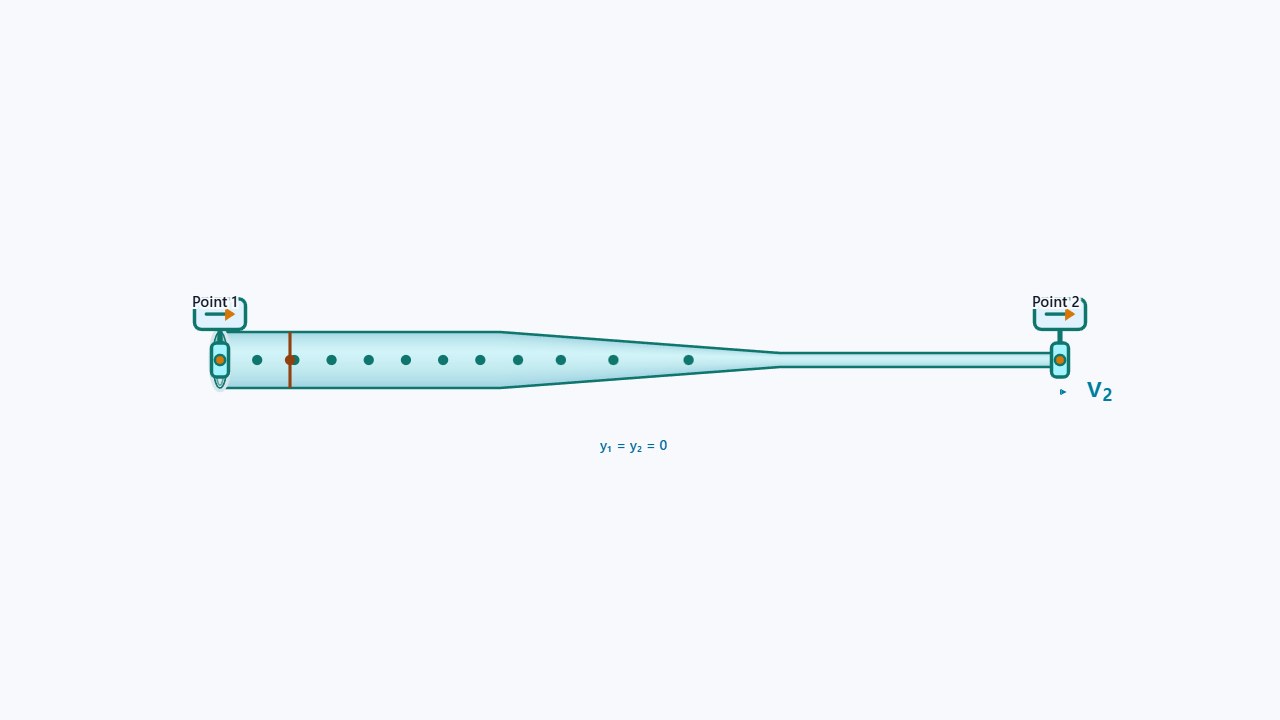
Combine continuity with Bernoulli’s equation. Account for both the speed change and elevation change, and keep absolute and gauge pressures consistent.
 BuildPhysics
AP Physics 1 · Unit 8 · Fluids
Connect pressure, speed, and elevation using continuity and energy per volume, then apply those ideas to tank outflow and fountains.
12 questions6 conceptual · 6 calculation
Start practiceFree · No account required · Self-paced
 Open interactive practice
What you’ll practice
Combine continuity with Bernoulli’s equation. Account for both the speed change and elevation change, and keep absolute and gauge pressures consistent.
Use a steady collection interval to calculate volume flow, convert opening area to SI units, and apply Torricelli’s relation to find the head above the outlet.
Find the underground supply pressure, then follow a water parcel after it leaves an atmospheric nozzle. Calculate vertical peak height and range for an angled launch.
A question from this set
An ideal, steady, incompressible flow passes into a narrower horizontal pipe section. There is no pump or dissipative loss between the two sections. What happens to the average speed and static pressure?
Try it in the practice setKey ideas
In a widening pipe that also climbs, the decrease in kinetic energy per volume competes with the increase in gravitational energy per volume. Compare both contributions before deciding how pressure changes.
For a horizontal restriction with fixed areas and density, doubling volume flow doubles both section speeds and quadruples the required pressure difference. The absolute pressure itself need not quadruple.
See the physics
After attempting a question, inspect section pressures, speeds, and energy per volume. Collect a steady jet over a measured interval, compare reservoir heads, and run a fountain to its recorded peak or ground-level landing.
Use a hint for a starting point or open a worked solution to follow the reasoning. Your progress saves in this browser, so you can return to unfinished questions.
Begin with a conceptual question, then work through the calculations.