Relate pipe size to fluid speed
Apply A₁v₁ = A₂v₂ through restrictions. Square radius or diameter factors before comparing speeds, then invert the relationship to design an outlet and calculate its percentage diameter reduction.
 BuildPhysics
AP Physics 1 · Unit 8 · Fluids
Connect pipe area and average speed with conserved volume flow, mass flow, and delivered volume.
12 questions6 conceptual · 6 calculation
Start practiceFree · No account required · Self-paced
 Open interactive practice
What you’ll practice
Apply A₁v₁ = A₂v₂ through restrictions. Square radius or diameter factors before comparing speeds, then invert the relationship to design an outlet and calculate its percentage diameter reduction.
Calculate m³/s and L/s from area and speed, then use density to find kg/s or g/s. For many parallel channels, compare the main vessel with the combined downstream area.
Find the area needed to deliver one room-volume of air in a specified interval. Integrate steady flow over time to predict collected volume, fill time, and delivered liquid mass.
A question from this set
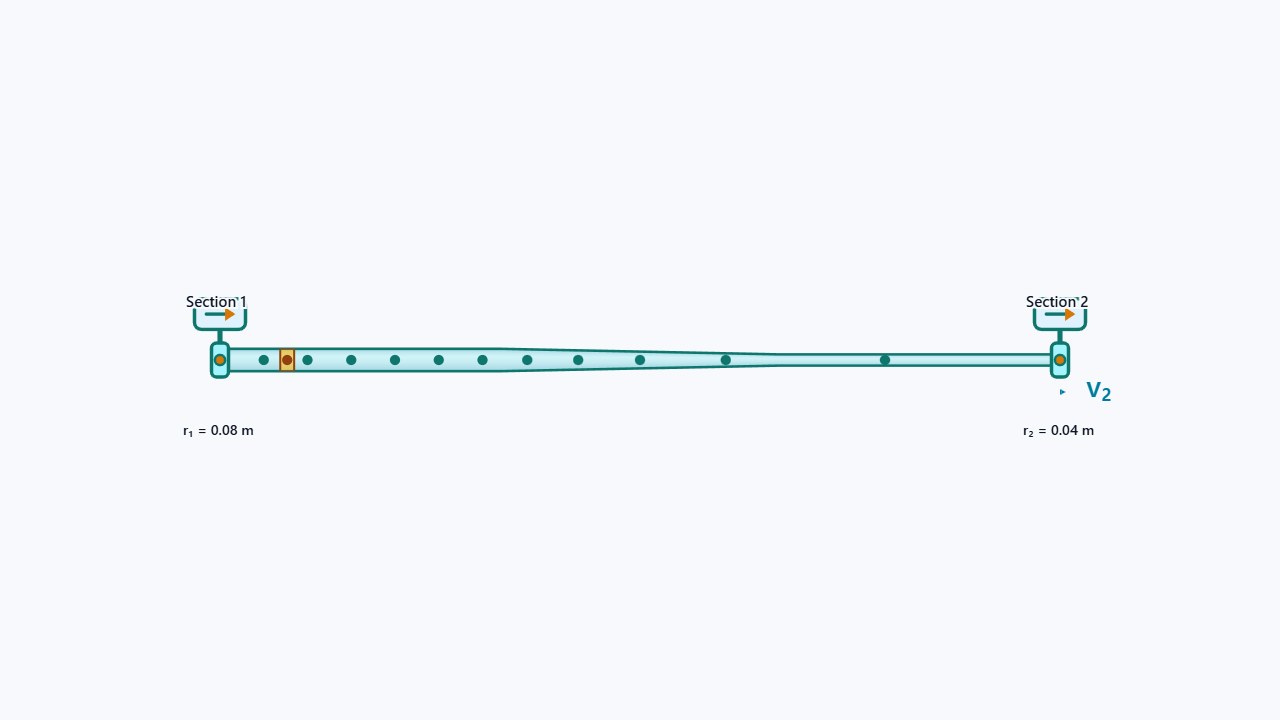
An incompressible liquid flows steadily through a full pipe with no leaks. Section 2 has one quarter of section 1’s cross-sectional area. Which comparison is correct?
Try it in the practice setKey ideas
In steady incompressible flow without leaks, the same volume crosses every section during the same interval. Narrowing a pipe changes the speed needed to carry that volume. It does not remove part of the flow.
Many small parallel channels can have a much larger combined area than the vessel feeding them. Divide total volume flow by that combined area to find the area-averaged speed.
See the physics
After attempting a question, watch tracers pass through a changing pipe and compare section measurements. Follow a fixed-volume parcel as its length changes, record a timed air-delivery interval, or let a liquid collection stop at its target volume.
Use a hint for a starting point or open a worked solution to follow the reasoning. Your progress saves in this browser, so you can return to unfinished questions.
Begin with a conceptual question, then work through the calculations.