Explain the force and acceleration
Distinguish changing direction from changing speed and predict the path if the gravitational attraction is removed.
 BuildPhysics
AP Physics 1 · Unit 2, Part 2 · Circular Motion and Gravity
Use gravity to explain circular satellite motion. Compare orbit sizes, calculate speeds and periods, and use orbital data to infer a planet’s mass.
12 questions6 conceptual · 6 calculation
Start practiceFree · No account required · Self-paced
 Open interactive practice
What you’ll practice
Distinguish changing direction from changing speed and predict the path if the gravitational attraction is removed.
Find speed, period, center radius, and altitude. Compare satellites at different radii and design a synchronous orbit.
Use a moon’s orbit or a graph relating period squared and radius cubed to infer the central mass.
A question from this set
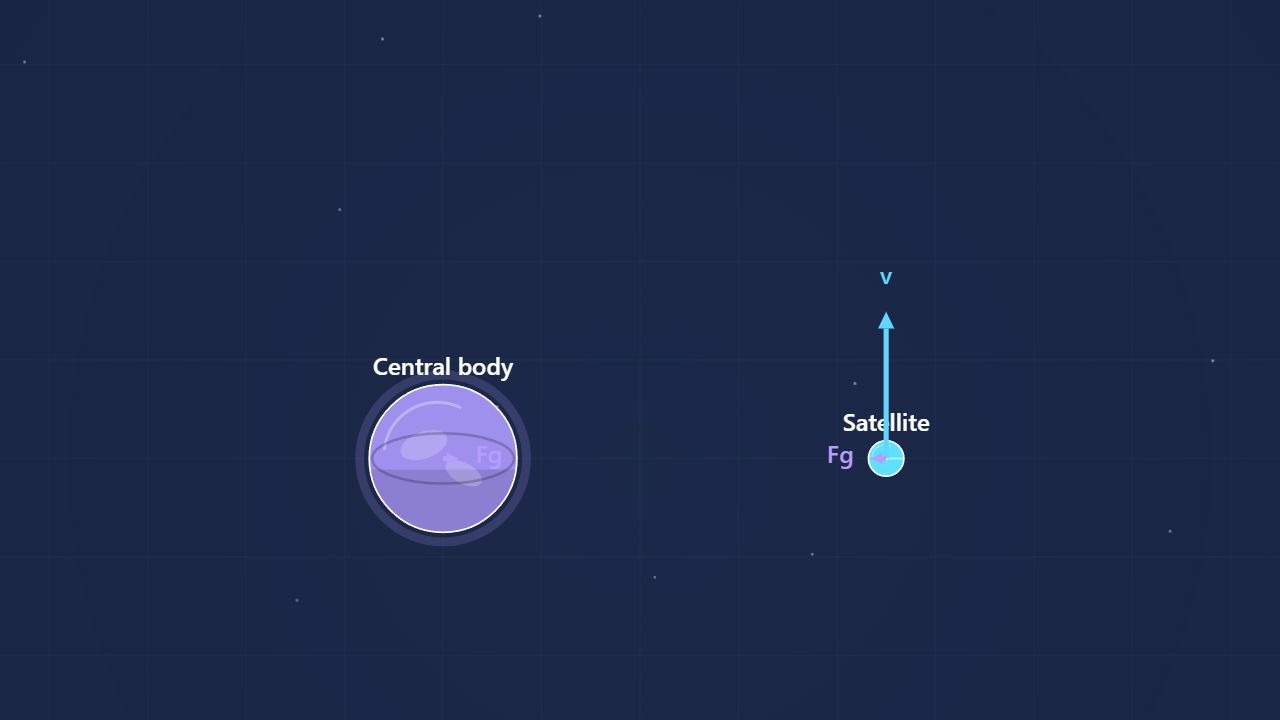
A satellite moves at constant speed in a circular orbit with its engines off. Which statement describes the force and acceleration on it?
Try it in the practice setKey ideas
The satellite’s velocity is tangent to its path. Gravity turns that velocity even when the speed stays constant and the engines are off.
A stated altitude is measured above the surface. Use the distance from the planet’s center in the orbit equations.
See the physics
After attempting a question, run the prepared satellite scene. Compare radius or mass variants, track the period, and inspect the orbit-data graphs or rotating-planet comparison.
Use a hint for a starting point or open a worked solution to follow the reasoning. Your progress saves in this browser, so you can return to unfinished questions.
Begin with a conceptual question, then work through the calculations.