Find a circular orbit
Compare launch conditions and observe the satellite’s path.
 BuildPhysics
AP Physics 1 · Unit 2, Part 2 · Circular Motion and Gravity
Launch a satellite and connect gravity, circular speed, and orbital period. Predict how a different orbital radius changes the motion.
Start lesson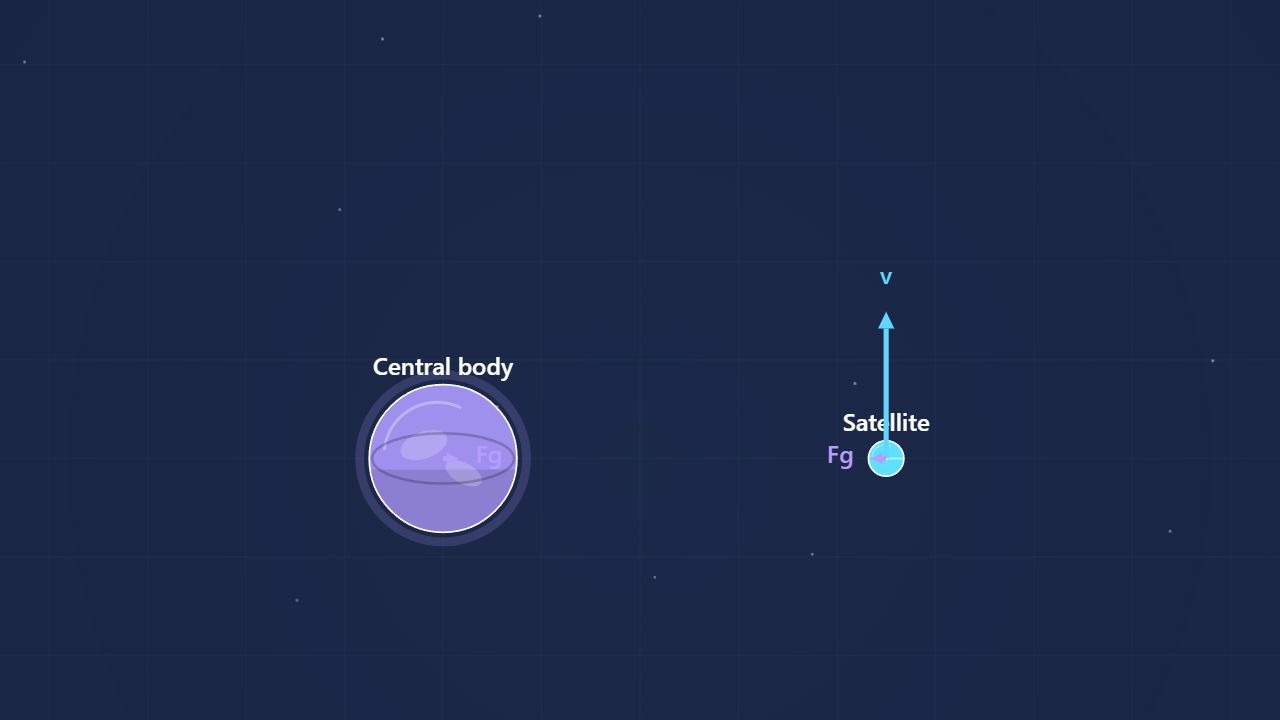 Start guided lesson
Learn by doing
Compare launch conditions and observe the satellite’s path.
Use gravitational force as the inward net force for circular motion.
Predict speed and period changes, then check them against the simulated orbit.
The big idea
For an ideal circular orbit around mass M, GMm/r2 = mv2/r. The orbiting mass cancels.
Circular speed is v = √(GM/r). Period is T = 2πr/v; a larger circular orbit is slower and takes longer.
A quick comparison
Compare circular orbits around the same source mass.
Larger radius → lower speed and longer period.
The first scene is set up. Start the lesson and explore.