Count angles beyond one turn
Distinguish repeated orientation from accumulated angular displacement. Use counterclockwise-positive angular quantities and separate angular distance from net angle through a reversal.
 BuildPhysics
AP Physics 1 · Unit 5 · Rotation
Connect a rotor’s angular motion with the motion of points at different radii. Practice clock-hand rates, rpm conversions, start-up and braking, rim acceleration components, and latitude-circle speeds.
13 questions6 conceptual · 7 calculation
Start practiceFree · No account required · Self-paced
 Open interactive practice
What you’ll practice
Distinguish repeated orientation from accumulated angular displacement. Use counterclockwise-positive angular quantities and separate angular distance from net angle through a reversal.
Convert rev/min to rad/s, use period to find angular velocity, and apply constant-angular-acceleration equations to a rotor starting or stopping.
Use v = r|ω|, tangential acceleration rα, and inward radial acceleration rω². Resolve perpendicular acceleration components and use R cos(latitude) for a latitude circle.
A question from this set
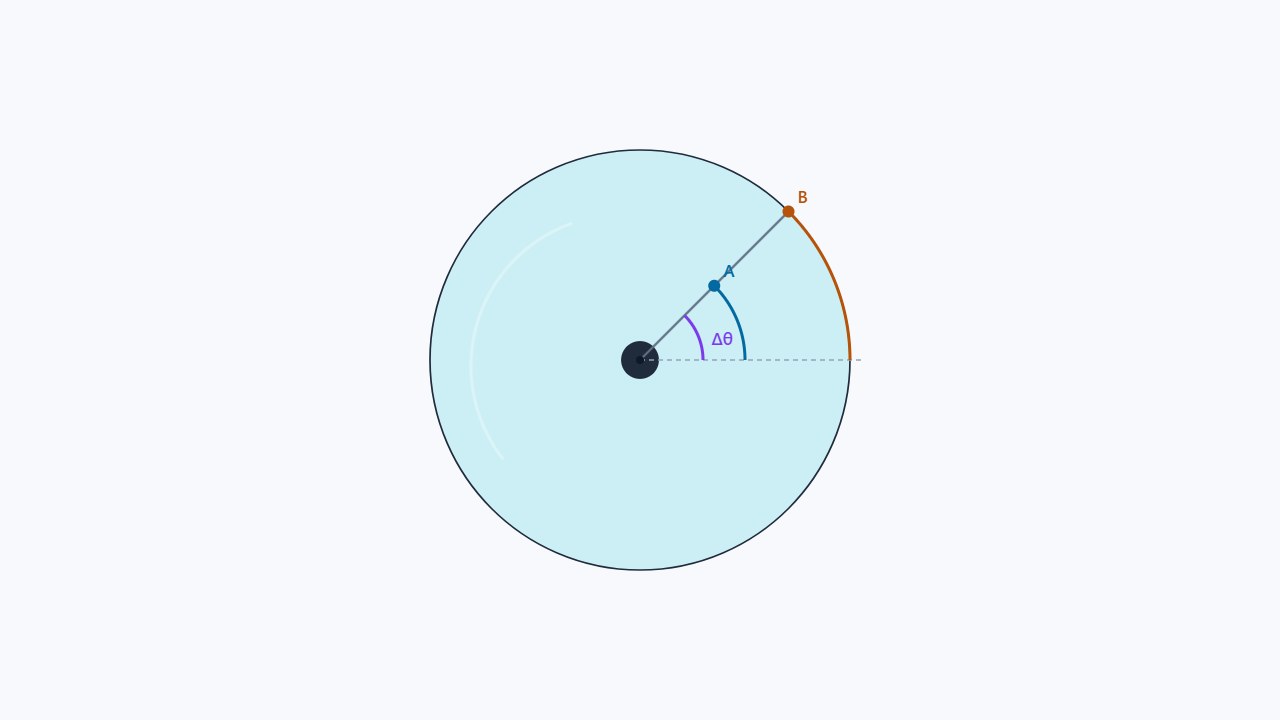
Points A and B are fixed to the same rigid rotor, with B twice as far from the axis as A. Which quantities must be the same for the two points?
Try it in the practice setKey ideas
A point near the axle and a point on the rim sweep out the same angle over the same time. The outer point travels a longer arc, giving it a greater linear speed.
At constant angular speed the rim point’s speed is steady, but its velocity changes direction. It still has inward radial acceleration. During spin-up, a tangential component also changes its speed.
See the physics
After attempting the question, run a native rotating body. Compare angular displacement, angular velocity, and angular acceleration graphs. Use separate clock-hand trials, rotor comparisons, and slow-motion close-ups of start-up and stopping. The displayed physical seconds explain differences in playback rate.
Use a hint for a starting point or open a worked solution to follow the reasoning. Your progress saves in this browser, so you can return to unfinished questions.
Begin with a conceptual question, then work through the calculations.