Use turns to measure travel and size
Convert tire dimensions and road distances into consistent units. Find accumulated angular distance, count revolutions over a warranty journey, and infer a rolling ball’s diameter from its travel.
 BuildPhysics
AP Physics 1 · Unit 5 · Rotation
Connect forward travel with tire rotation, follow a coin to its first stop, and find a ball’s diameter from its turns. Then compare touching rollers and combine translation with rotation to find rim-point velocities.
12 questions6 conceptual · 6 calculation
Start practiceFree · No account required · Self-paced
 Open interactive practice
What you’ll practice
Convert tire dimensions and road distances into consistent units. Find accumulated angular distance, count revolutions over a warranty journey, and infer a rolling ball’s diameter from its travel.
Connect center acceleration with angular acceleration while maintaining a consistent clockwise sign. Find a braking coin’s first-stop distance and time without extending the model into a reversal.
Match the tangential velocities of externally touching rollers. Add center translation and rotational velocity at the top, bottom, and side of a rolling wheel in the ground frame.
A question from this set
A wheel rolls to the right on stationary ground. Which condition distinguishes rolling without slipping from a wheel that is also sliding?
Try it in the practice setKey ideas
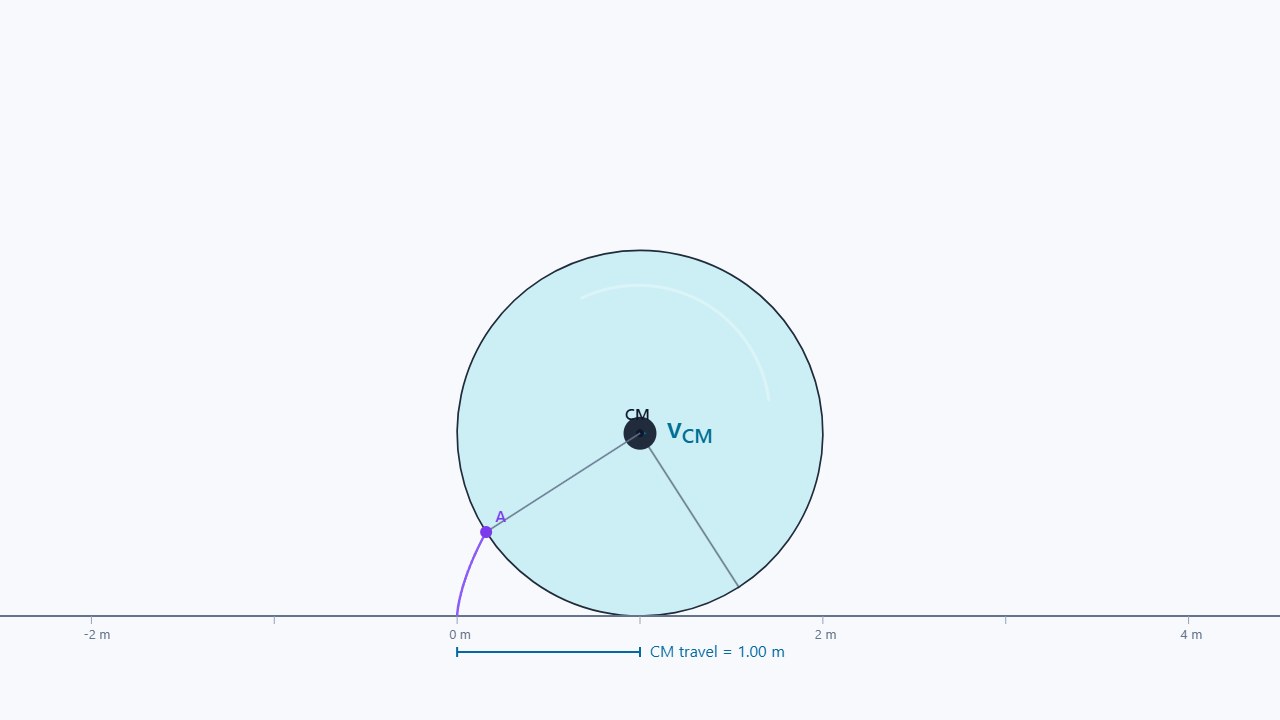
At ground contact, the wheel’s translational and rotational velocity contributions cancel. At the top they reinforce, while at the side they form perpendicular components. The material point at contact changes continuously.
Kinetic friction opposes sliding at the contact, which can differ from the center’s direction. When contact does not slide, friction is static if a force is needed; an ideal wheel can also roll steadily with zero friction.
See the physics
After attempting a question, run the prepared wheel. Compare center travel with rim arc and watch contact velocity approach zero in the slipping trials. The warranty animation uses a short measured sample to project the full distance; the coin pauses at its first stop, and the tire has a final-interval close-up.
Use a hint for a starting point or open a worked solution to follow the reasoning. Your progress saves in this browser, so you can return to unfinished questions.
Begin with a conceptual question, then work through the calculations.