Choose each kinetic-energy term
Use ½Mv² for center-of-mass motion and ½ICMω² for spin about the center. Keep fixed-axis rotation separate from rolling translation so energy is not counted twice.
 BuildPhysics
AP Physics 1 · Unit 6 · Rotating Systems
Separate the energy of a moving center from the energy of spin. Compare rolling hoops, cylinders, spheres and shells, calculate work from a string pull or constant torque, and track energy shared by a falling bucket and a fixed spool.
12 questions6 conceptual · 6 calculation
Start practiceFree · No account required · Self-paced
 Open interactive practice
What you’ll practice
Use ½Mv² for center-of-mass motion and ½ICMω² for spin about the center. Keep fixed-axis rotation separate from rolling translation so energy is not counted twice.
Use the correct hoop, cylinder, sphere and shell inertias. Explain why the fastest center has the smallest rotational share when equal masses roll from the same height.
Use Fs for a string pull and τΔθ for a constant torque. Convert revolutions to radians and include both the bucket’s translation and the fixed spool’s rotation.
A question from this set
A rotor has fixed moment of inertia I. If its angular speed doubles, how does its rotational kinetic energy change?
Try it in the practice setKey ideas
For I = kMR² and rolling without slipping, total kinetic energy is ½Mv²(1 + k). At a shared vertical drop, a larger rotational share means a smaller center speed.
Rotational kinetic energy depends on ω². Clockwise and counterclockwise rotation at the same speed have the same energy, while work depends on torque and angular displacement together.
See the physics
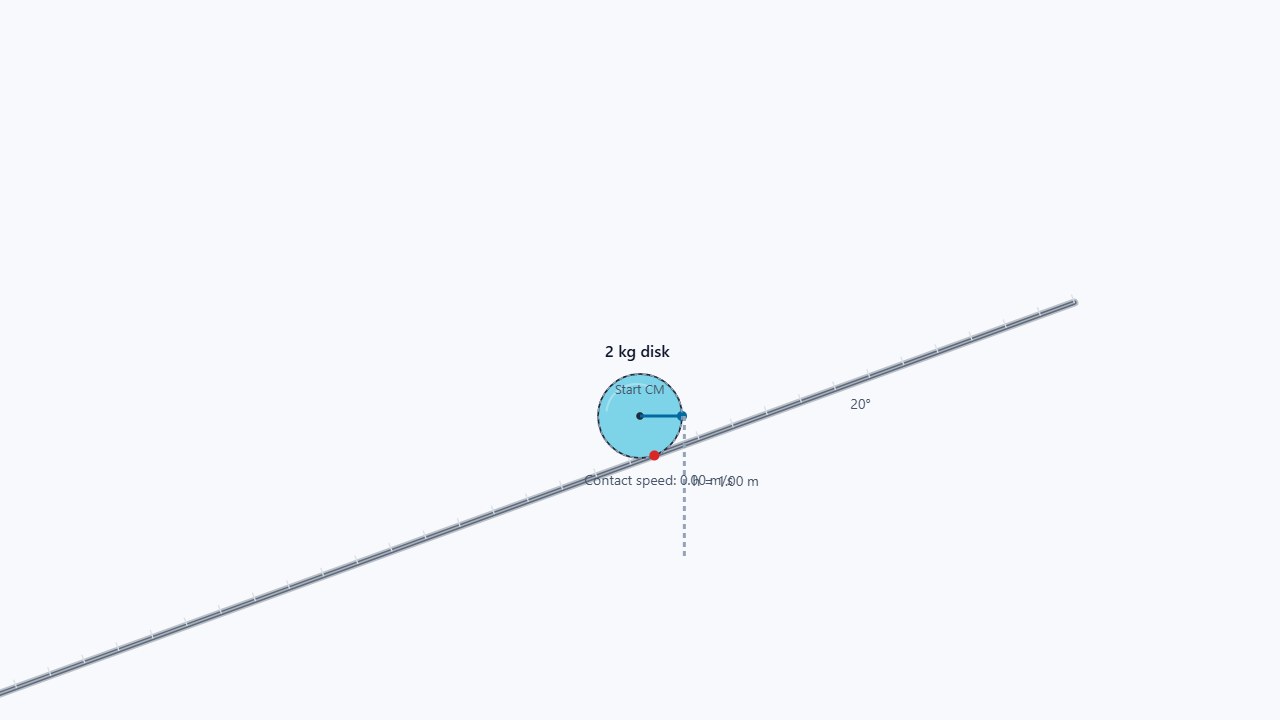
After attempting the questions, compare recorded translational, rotational and gravitational energies with initial energy plus supplied work. Switch shapes or peg radii, reverse a torque-driven rotor, and measure the bucket and sphere at their actual markers.
Use a hint for a starting point or open a worked solution to follow the reasoning. Your progress saves in this browser, so you can return to unfinished questions.
Begin with a conceptual question, then work through the calculations.