Read the ellipse and its motion vectors
Distinguish a focus from the geometric center and compare velocity, acceleration, and swept areas around the orbit.
 BuildPhysics
AP Physics 1 · Unit 6 · Rotating Systems
Follow a spacecraft around an ellipse, connect changing speed with gravitational energy, and compare bound orbits with escape conditions.
12 questions6 conceptual · 6 calculation
Start practiceFree · No account required · Self-paced
 Open interactive practice
What you’ll practice
Distinguish a focus from the geometric center and compare velocity, acceleration, and swept areas around the orbit.
Find the semimajor axis and period, connect speeds at different radii, and calculate changes in kinetic and gravitational potential energy.
Find the energy needed for a circular-orbit transfer, the escape threshold, and the remaining speed at large separation. Include both sources in the capsule comparison.
A question from this set
A spacecraft travels counterclockwise around a planet at a focus. A is the farthest point on the right and B the nearest point on the left. Which vector description is correct?
Try it in the practice setKey ideas
Velocity follows the path’s tangent, while gravitational acceleration points toward the source. The spacecraft moves faster nearer the source.
These questions set gravitational potential energy to zero at infinite separation. Keep that reference consistent when comparing bound motion and escape.
See the physics
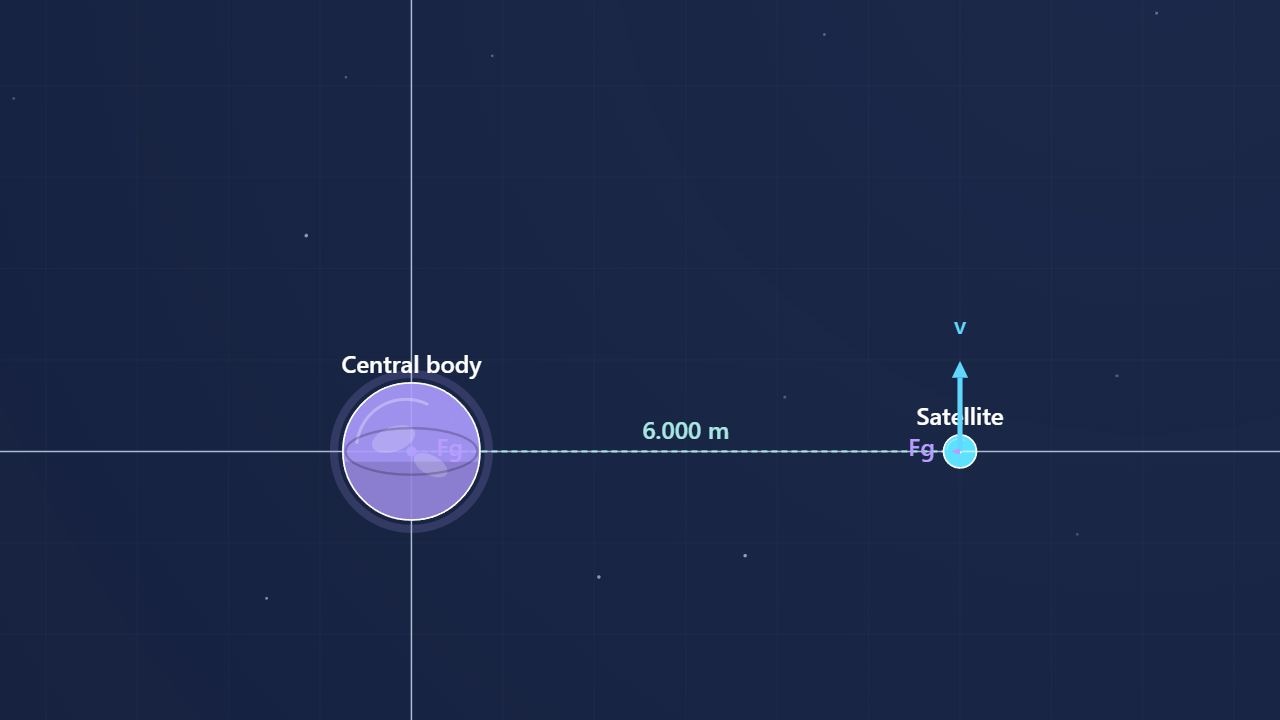
After attempting a question, run the original gravitational scene. Inspect near and far passages, swept areas, and physical-unit readouts, then compare the transfer or escape variants.
Use a hint for a starting point or open a worked solution to follow the reasoning. Your progress saves in this browser, so you can return to unfinished questions.
Begin with a conceptual question, then work through the calculations.