Explain forces and motion
Identify the forces after release, compare velocity with net force, and distinguish a balanced pair on one object from an interaction pair on two objects.
 BuildPhysics
AP Physics 1 · Unit 2, Part 1 · Forces
Review forces through 20 questions that combine diagrams, Newton’s laws, elevators, ropes, ramps, friction, and contact interactions. Choose a system and connect its force model to its motion.
20 questions10 conceptual · 10 calculation
Start practiceFree · No account required · Self-paced
 Open interactive practice
What you’ll practice
Identify the forces after release, compare velocity with net force, and distinguish a balanced pair on one object from an interaction pair on two objects.
Find forces for steady motion, angled cables, a braking elevator, and two blocks accelerated by one push. Choose axes and combine components.
Solve pulley and cart systems, compare static and sliding friction, and account for how an angled pull changes support and acceleration.
A question from this set
A ball has left a student’s hand and is still moving upward. Ignore air resistance. Which free-body diagram correctly represents the ball during its upward flight?
Try it in the practice setKey ideas
Select the object or system and identify its external forces. Use separate equations for different objects when the requested tension or contact force is internal to a larger system.
A steady velocity means zero acceleration and balanced forces. Slowing requires acceleration opposite to velocity, even if the object is still traveling upward or forward.
See the physics
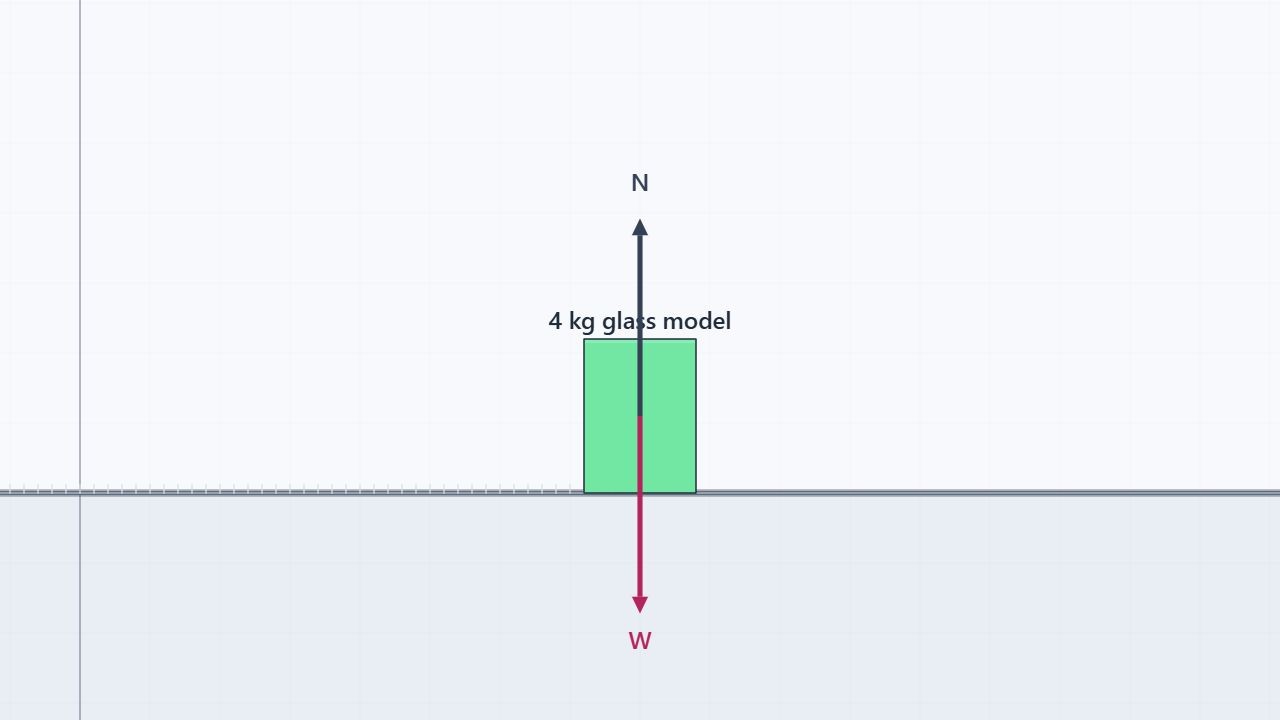
After each attempted question, run its prepared scene. Compare a released ball, a changing elevator reading, connected loads, sliding ramp crates, and contacting blocks with your force diagrams and calculations.
Use a hint for a starting point or open a worked solution to follow the reasoning. Your progress saves in this browser, so you can return to unfinished questions.
Begin with a conceptual question, then work through the calculations.