Distinguish static and kinetic friction
Find the actual static friction below breakaway and compare it with the maximum available value. Use kinetic friction when surfaces slide.
 BuildPhysics
AP Physics 1 · Unit 2, Part 1 · Forces
Choose the correct friction model before calculating a force. Practice breakaway limits, skidding, rough ramps, angled pushes and pulls, and friction in a connected system.
12 questions6 conceptual · 6 calculation
Start practiceFree · No account required · Self-paced
 Open interactive practice
What you’ll practice
Find the actual static friction below breakaway and compare it with the maximum available value. Use kinetic friction when surfaces slide.
Account for upward pulls, downward pushes, and ramp contact before calculating a friction limit or sliding force.
Calculate a skidding vehicle’s stopping behavior, compare rest and sliding in a connected system, and analyze the angle at which a ramp loses static support.
A question from this set
A box stays at rest while a 12.0 N horizontal push acts to the right. Its maximum available static friction is greater than 12.0 N. What is the actual friction force?
Try it in the practice setKey ideas
For surfaces that remain at rest relative to one another, the required friction may be below μₛN. Solve the force balance and check it against the available maximum.
In this introductory model, sliding friction has magnitude μₖN and opposes relative sliding at the contact. The normal force can change when another force has a vertical component.
See the physics
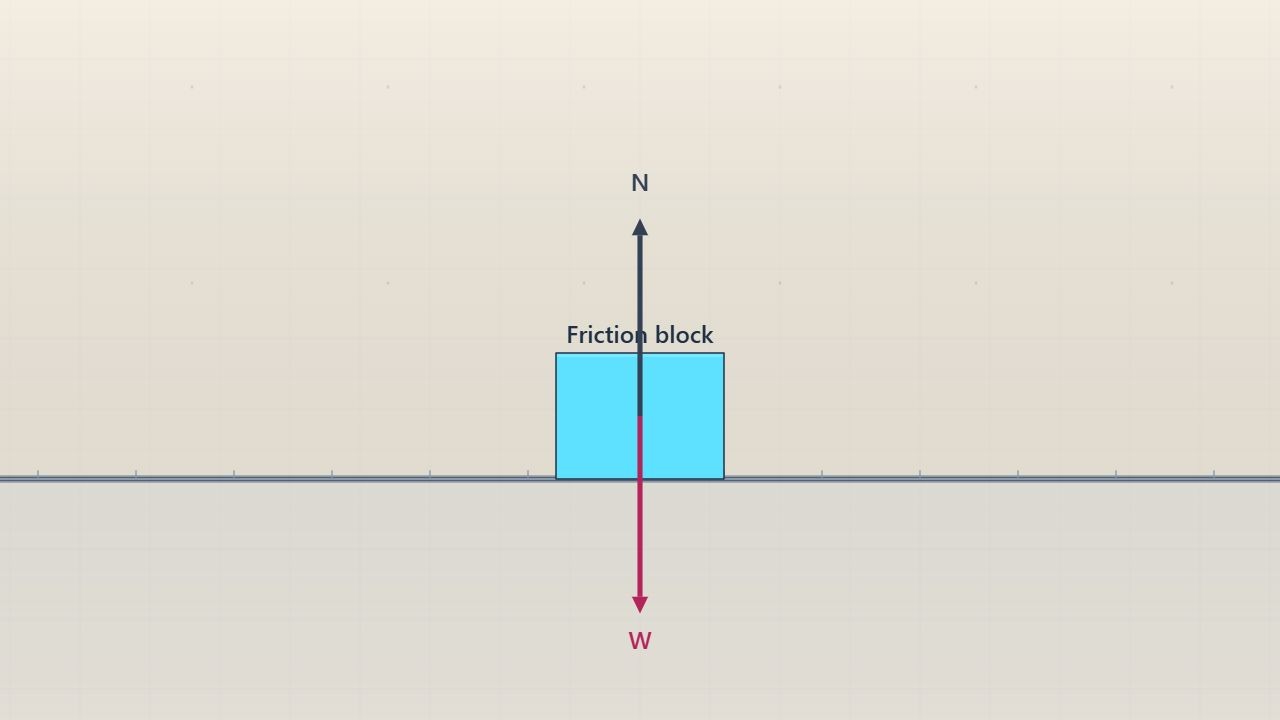
Check your answer, then vary between the prepared pushes or contact conditions. Compare a box that remains still with a sliding object, and inspect the friction and normal-force values after running.
Use a hint for a starting point or open a worked solution to follow the reasoning. Your progress saves in this browser, so you can return to unfinished questions.
Begin with a conceptual question, then work through the calculations.