Identify work and power signs
Compare forces perpendicular to motion, braking forces, and motors at steady speed. Explain how speed changes affect kinetic energy.
 BuildPhysics
AP Physics 1 · Unit 3 · Energy
Review work, energy, springs, and power through 20 questions. Choose an energy system, combine transfers and stores, and explain motion on rough tracks, ramps, swings, and powered lifts.
20 questions10 conceptual · 10 calculation
Start practiceFree · No account required · Self-paced
 Open interactive practice
What you’ll practice
Compare forces perpendicular to motion, braking forces, and motors at steady speed. Explain how speed changes affect kinetic energy.
Solve drops, spring releases, rough ramps, angled motor pulls, and swings. Choose the reference for gravitational potential energy consistently.
Calculate work from a changing force–position graph. Connect useful lifting work with average power and compare motion at selected points.
A question from this set
A package slides along a frictionless horizontal shelf. The shelf pushes upward on it throughout the slide. What work does that normal force do?
Try it in the practice setKey ideas
Add the work of the forces acting on an object to find ΔK. When using potential-energy stores for a larger system, account for the same interactions within those stores.
Work and energy totals do not say how quickly the transfer occurs. Use elapsed time for average power or the current force and velocity for instantaneous power.
See the physics
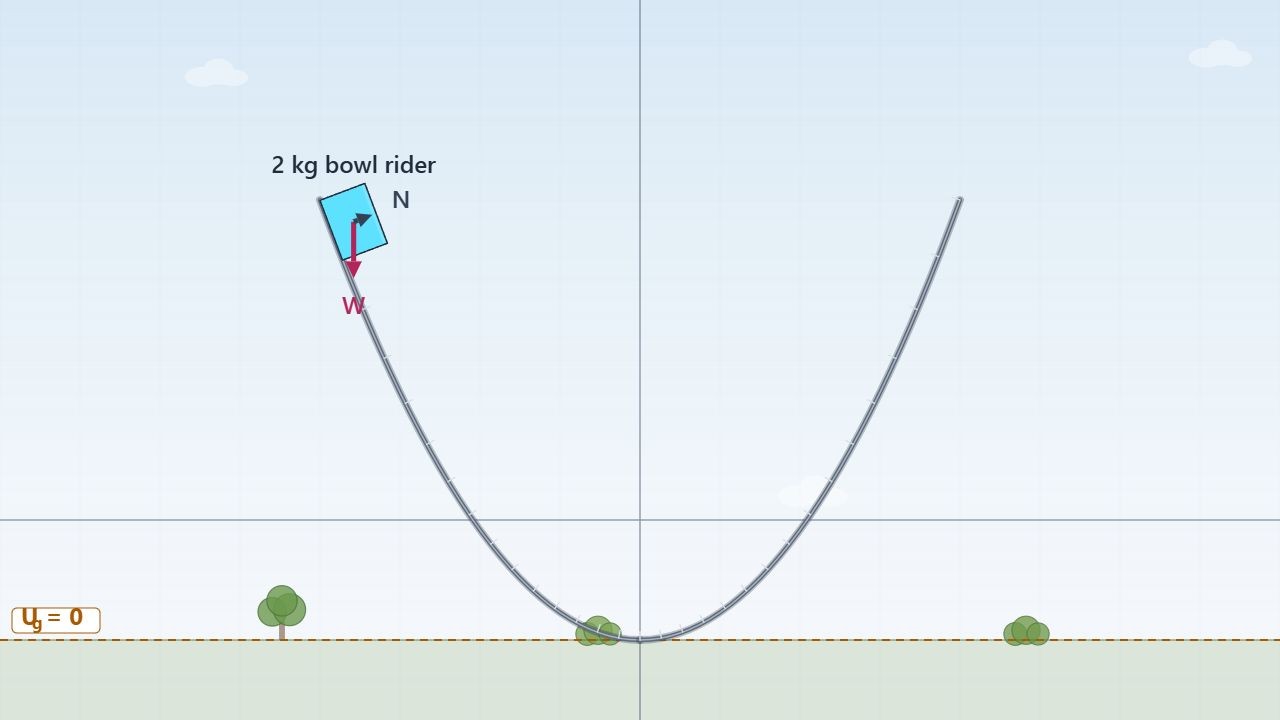
Check each response before opening its scene. Compare a supported package, braking cart, projectile, spring-driven cart, swing, and powered cable with the work and energy quantities in your solution.
Use a hint for a starting point or open a worked solution to follow the reasoning. Your progress saves in this browser, so you can return to unfinished questions.
Begin with a conceptual question, then work through the calculations.