Compare work and average power
Find work over a time interval and explain how completing the same lift sooner changes average power. Compare two accelerating motor trials.
 BuildPhysics
AP Physics 1 · Unit 3 · Energy
Compare how quickly work is done and energy is transferred. Practice average and instantaneous power in lifts, accelerating motors, braking, angled pulls, and a changing force graph.
12 questions6 conceptual · 6 calculation
Start practiceFree · No account required · Self-paced
 Open interactive practice
What you’ll practice
Find work over a time interval and explain how completing the same lift sooner changes average power. Compare two accelerating motor trials.
Use the component of force along velocity. Distinguish a motor’s power from net power and determine when a brake’s power is negative.
Calculate useful motor efficiency and use a force–position graph to connect work, speed, and power at selected positions.
A question from this set
Two motors lift identical loads through the same vertical height at constant speed. One completes the lift in half the time. How do the useful work and average mechanical power compare?
Try it in the practice setKey ideas
For a specified interval, Pavg = W/Δt. Two motors can do the same useful work but have different average powers because their completion times differ.
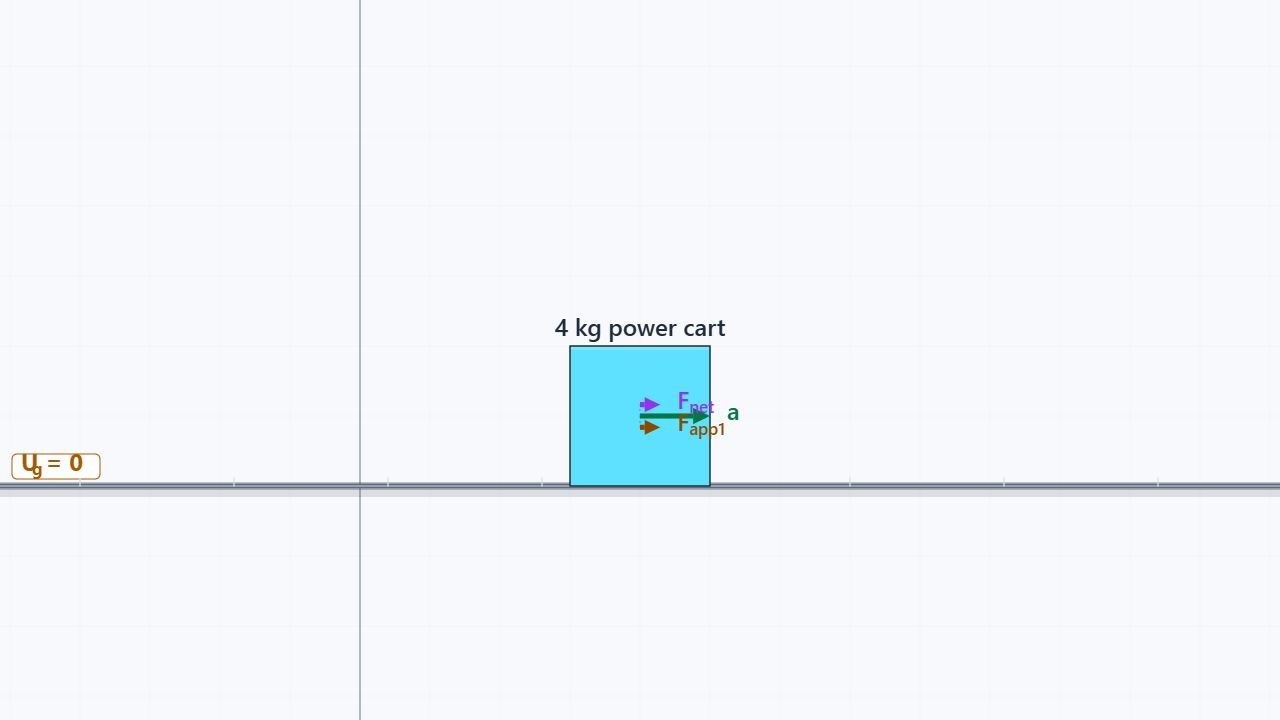
For one force, P = Fv cos θ. With a constant force parallel to an accelerating cart, power increases as the cart speeds up. A perpendicular force delivers zero mechanical power.
See the physics
Check your response, then switch motor trials and inspect height, work, elapsed time, and power. Other questions compare braking and accelerating motion with the power at a particular instant.
Use a hint for a starting point or open a worked solution to follow the reasoning. Your progress saves in this browser, so you can return to unfinished questions.
Begin with a conceptual question, then work through the calculations.