Locate a weighted position
Change masses and positions to predict where the center of mass lies.
 BuildPhysics
AP Physics 1 · Unit 4 · Linear Momentum
Move masses, locate their shared center of mass, and explain how a system can move predictably while its parts interact.
Start lesson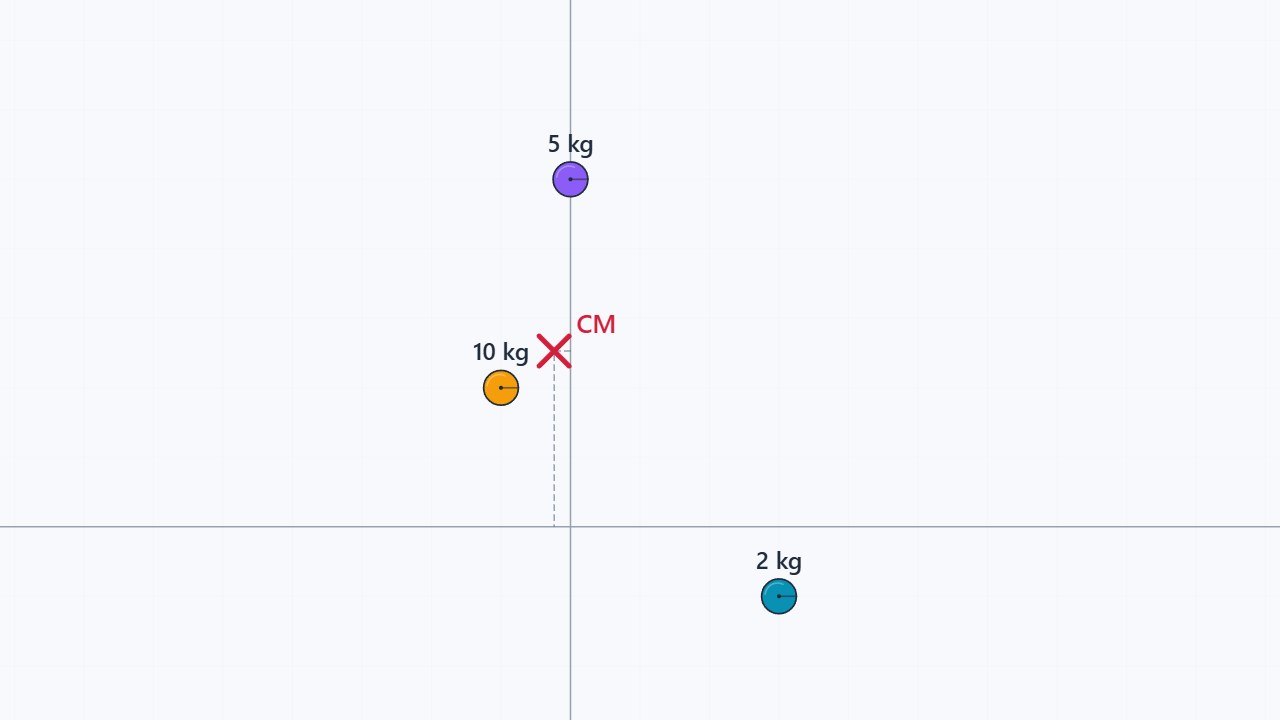 Start guided lesson
Learn by doing
Change masses and positions to predict where the center of mass lies.
Relate total momentum to center-of-mass velocity and external force to its acceleration.
Use a separating projectile to compare the parts’ paths with the center-of-mass path.
The big idea
For two objects, xCM = (m1x1 + m2x2)/(m1 + m2). The result lies closer to the heavier object.
Internal interactions can rearrange the parts without changing total momentum. The net external force determines the center of mass’s acceleration.
A quick comparison
Place masses m and 2m at opposite ends of a light connecting line.
The center of mass lies closer to 2m.
The first scene is set up. Start the lesson and explore.