BuildPhysics

AP Physics 1 · Unit 4 · Linear Momentum

Momentum and Impulse

Change a force pulse, compare the resulting motion, and connect force–time area with impulse and change in momentum.

Start lesson
  • Free
  • No account required
  • Self-paced
Momentum and Impulse guided lesson preview Start guided lesson
Explore the model. Make predictions. Check your thinking.

Learn by doing

Three ideas you’ll put into motion

Measure momentum

Compare how mass and signed velocity determine an object’s momentum.

Change a force pulse

Investigate how force magnitude and contact time affect the momentum change.

Use graph evidence

Read a force–time area and compare the impulse with measured initial and final momentum.

The big idea

The key ideas, at a glance.

Momentum includes direction

Linear momentum is p = mv. Keep the velocity sign when calculating a component of momentum.

Impulse changes momentum

Net impulse is J = Δp. The signed area under a net-force–time graph gives the same momentum change.

A quick comparison

Compare two constant-force pulses with equal force, one lasting twice as long.

Same force → twice the impulse for twice the time.

net forcetimeSchematic relationship
Teaching this topic?Classroom fit, AP connections, and support
Classroom fit
Use for a concept introduction, guided independent practice, or a projected class discussion.
Before students begin
Velocity, Newton’s second law, and areas of rectangles and triangles.
Built-in support
Prepared scenes, guided prompts, and feedback on lesson questions.
AP Physics 1 connections
Unit 4: linear momentum, impulse, and force–time representations.
Check for understanding
Ask how a longer stopping time can reduce average force for the same momentum change.
Optional extension
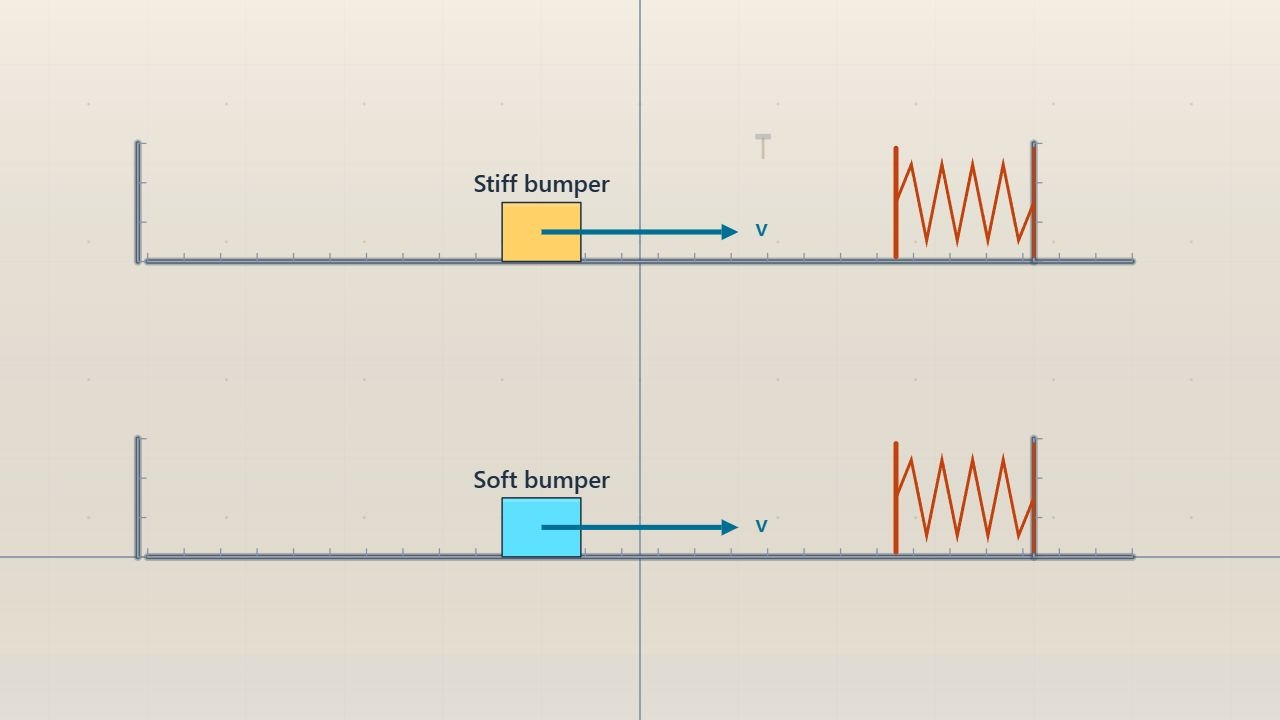
Explore the Impulse with Spring Bumpers lab.
Meet the educator behind Build Physics

Ready to test your thinking?

The first scene is set up. Start the lesson and explore.

Start lesson