Weight each position by mass
Include a uniform bar’s own mass, keep negative coordinates in a two-dimensional average, and distinguish a coordinate from a distance to another endpoint.
 BuildPhysics
AP Physics 1 · Unit 4 · Momentum
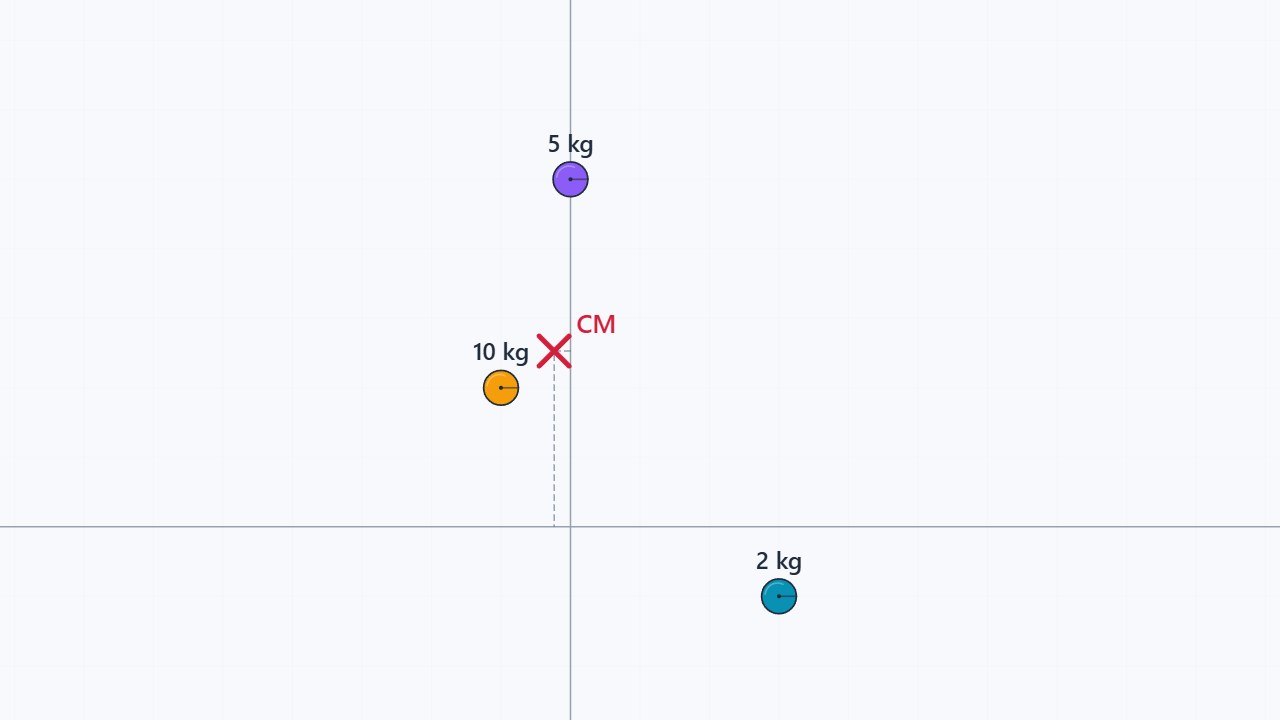
Find a system’s mass-weighted position and follow how that point moves. Practice loaded bars, masses on a coordinate plane, colliding carts, a recoiling guide, a separating projectile, and a person crossing a floating platform.
12 questions6 conceptual · 6 calculation
Start practiceFree · No account required · Self-paced
 Open interactive practice
What you’ll practice
Include a uniform bar’s own mass, keep negative coordinates in a two-dimensional average, and distinguish a coordinate from a distance to another endpoint.
Use total momentum to find center-of-mass velocity. Compare rebound and sticking trials, internal force pairs, and a net external push.
Include both objects’ kinetic energies for a recoiling guide. Separate shore-frame motion from walking speed relative to a floating platform, and conserve fragment momentum component by component.
A question from this set
Two straight rods have the same length. One has uniform density and cross section; the other contains more mass near its right end. Which statement about their centers of mass is correct?
Try it in the practice setKey ideas
A uniform rod has its center of mass at its midpoint. Extra mass near one end shifts that point. Multiplying all masses by the same factor leaves the center unchanged when positions stay fixed.
For a fixed-mass system, total momentum is MvCM and the net external force is M aCM. Internal collisions and releases can change the parts’ motion while preserving the same center-of-mass motion.
See the physics
After checking an answer or calculation parts, run the prepared scene. Compare measured object and center-of-mass traces, watch a moving guide recoil, and follow the person to the platform’s moving far end. The marker and calculated values appear after an attempted run.
Use a hint for a starting point or open a worked solution to follow the reasoning. Your progress saves in this browser, so you can return to unfinished questions.
Begin with a conceptual question, then work through the calculations.