BuildPhysics

AP Physics 1 · Unit 7 · Oscillations

Period of a Mass on a Spring

Measure complete cycles, vary mass, stiffness and amplitude, run two setups together, and calculate mass for a requested period.

Start lesson
  • Free
  • No account required
  • Self-paced
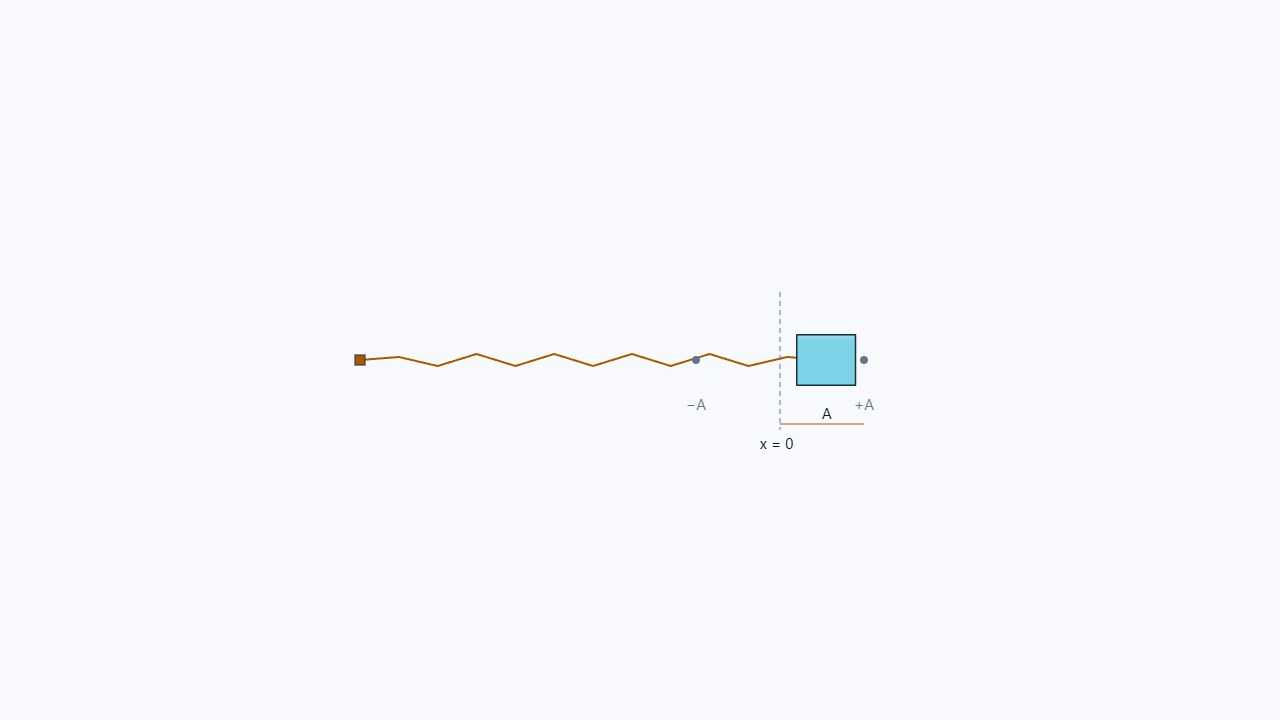
Period of a Mass on a Spring guided lesson preview Start guided lesson
Explore the model. Make predictions. Check your thinking.

Learn by doing

Three ideas you’ll put into motion

Measure period

Use crossings with matching direction and divide elapsed time by cycle count.

Compare controlled trials

Change one physical parameter and retain actual measurements.

Calculate a required mass

Use the period equation to calculate mass and select a multiple-choice answer.

The big idea

The key ideas, at a glance.

Restoring acceleration sets the period

a = −(k/m)x gives ω² = k/m and T = 2π√(m/k).

Amplitude changes energy

Ideal spring period is independent of amplitude even though energy and maximum speed change.

A quick comparison

Increase mass by a factor of four at fixed spring stiffness.

The period doubles.

mass mmass 4mT ∝ √m
Teaching this topic?Classroom fit, AP connections, and support
Classroom fit
Use for a concept introduction, guided independent practice, or a projected class discussion.
Before students begin
Newton’s second law, Hooke’s law and cycle measurement.
Built-in support
Prepared scenes, guided prompts, and feedback on lesson questions.
AP Physics 1 connections
Unit 7: spring oscillation period and proportional reasoning.
Check for understanding
Ask for simultaneous mass and stiffness changes that preserve a measured period.
Meet the educator behind Build Physics

Ready to test your thinking?

The first scene is set up. Start the lesson and explore.

Start lesson