BuildPhysics

AP Physics 1 · Unit 7 · Oscillations

Graphing Spring Simple Harmonic Motion

Connect spring motion to recorded displacement, velocity and acceleration graphs using slope, area and a shared time cursor.

Start lesson
  • Free
  • No account required
  • Self-paced
Graphing Spring Simple Harmonic Motion guided lesson preview Start guided lesson
Explore the model. Make predictions. Check your thinking.

Learn by doing

Three ideas you’ll put into motion

Coordinate representations

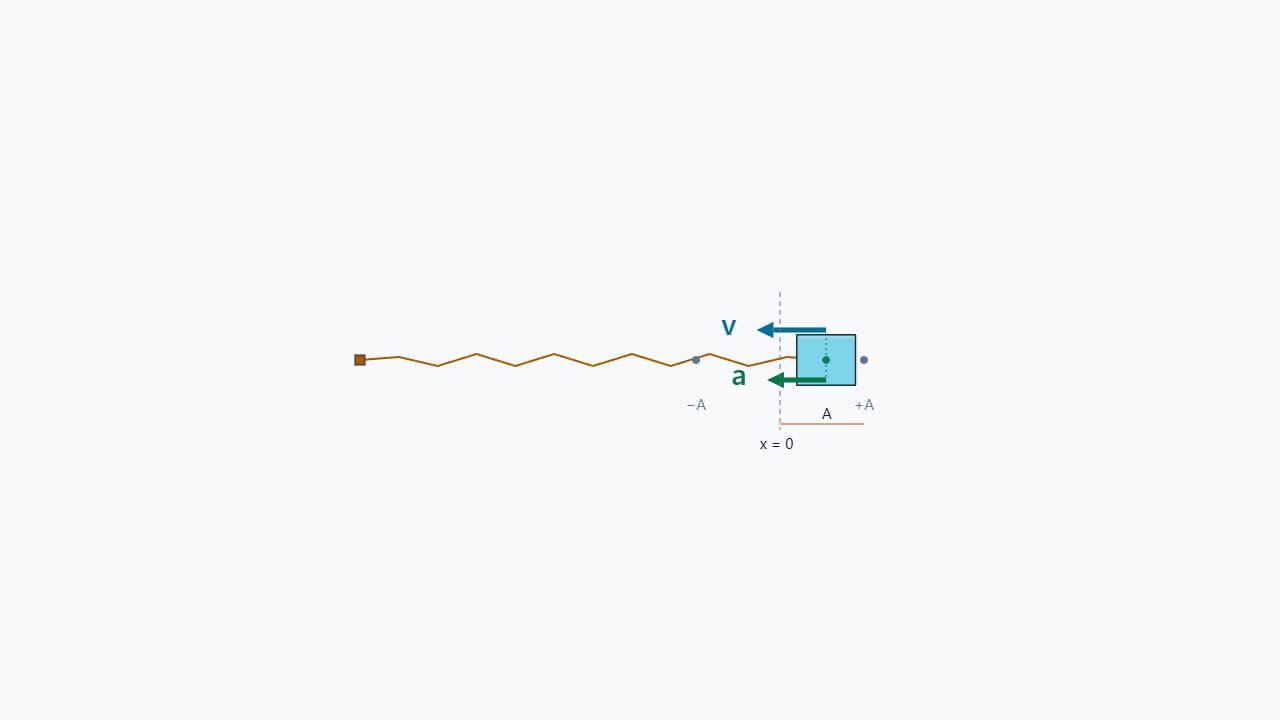
Inspect the same quarter-cycle instant on the apparatus and graphs.

Measure graph relationships

Use local slopes and signed areas from recorded motion.

Model a new release

Relate period, frequency and sine or cosine models to starting conditions.

The big idea

The key ideas, at a glance.

Graphs describe the same motion

Position slope is velocity; velocity slope is acceleration. Signed area under velocity gives displacement.

Phase describes cycle progress

Frequency is 1/T and angular frequency is 2π/T. A cosine describes release from the positive turning point.

A quick comparison

Compare the positive displacement peak and first negative velocity peak.

The peaks are separated by a quarter cycle.

positive x peaknegative v peakTime offset = T/4
Teaching this topic?Classroom fit, AP connections, and support
Classroom fit
Use for a concept introduction, guided independent practice, or a projected class discussion.
Before students begin
Spring SHM, graph slope and area, period and basic trigonometric functions.
Built-in support
Prepared scenes, guided prompts, and feedback on lesson questions.
AP Physics 1 connections
Unit 7: representations, period, frequency and phase in SHM.
Check for understanding
Ask for the initial signs and slopes after release from a negative turning point.
Meet the educator behind Build Physics

Ready to test your thinking?

The first scene is set up. Start the lesson and explore.

Start lesson