Explain restoring motion
Connect Hooke’s law and Newton’s second law to proportional restoring acceleration.
 BuildPhysics
AP Physics 1 · Unit 7 · Oscillations
Follow a spring through exact center crossings and turning points, compare energy stores, and test a new amplitude.
Start lesson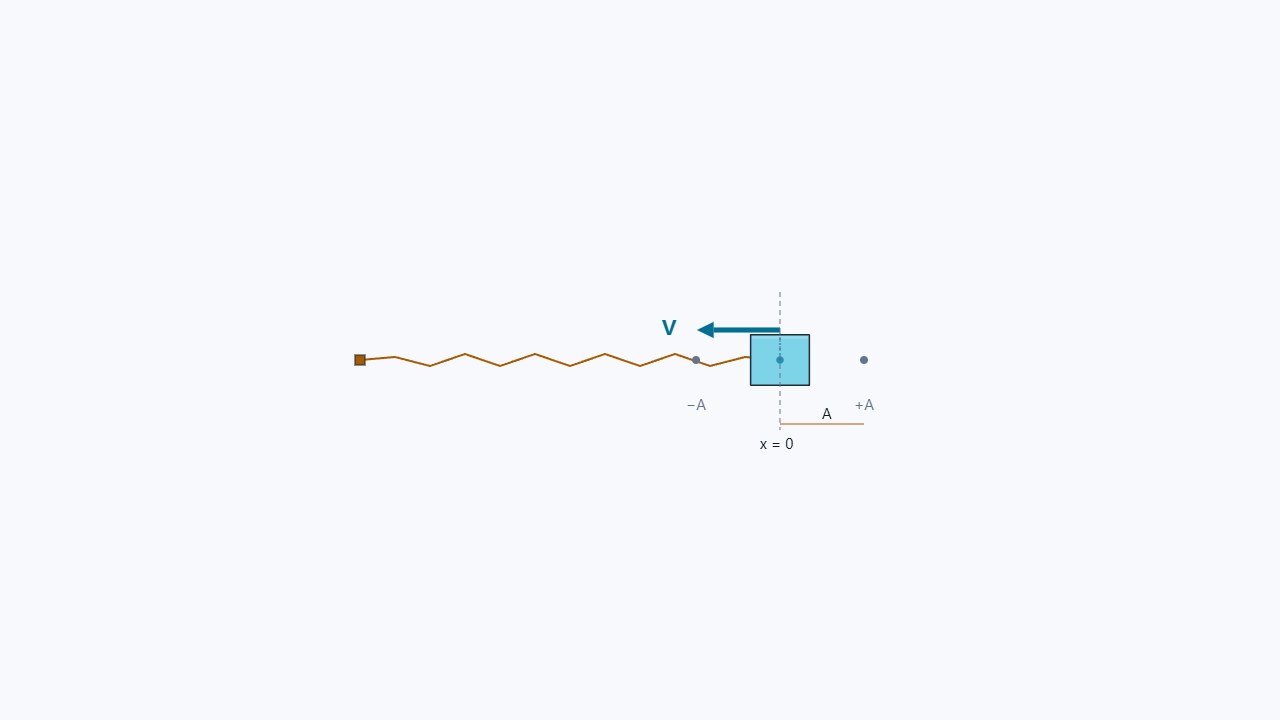 Start guided lesson
Learn by doing
Connect Hooke’s law and Newton’s second law to proportional restoring acceleration.
Compare kinetic and spring potential energy at the center, endpoints and an intermediate point.
Change the actual release displacement and compare recorded energy and speed.
The big idea
For an ideal spring, a = −(k/m)x, where x is displacement from equilibrium.
K + Uₛ stays constant without dissipation. At equilibrium speed is greatest; at a turning point it is zero.
A quick comparison
Double amplitude while keeping mass and stiffness fixed.
Total energy becomes four times as large.
The first scene is set up. Start the lesson and explore.