BuildPhysics

AP Physics 1 · Unit 2, Part 1 · Forces

Newton’s Third Law

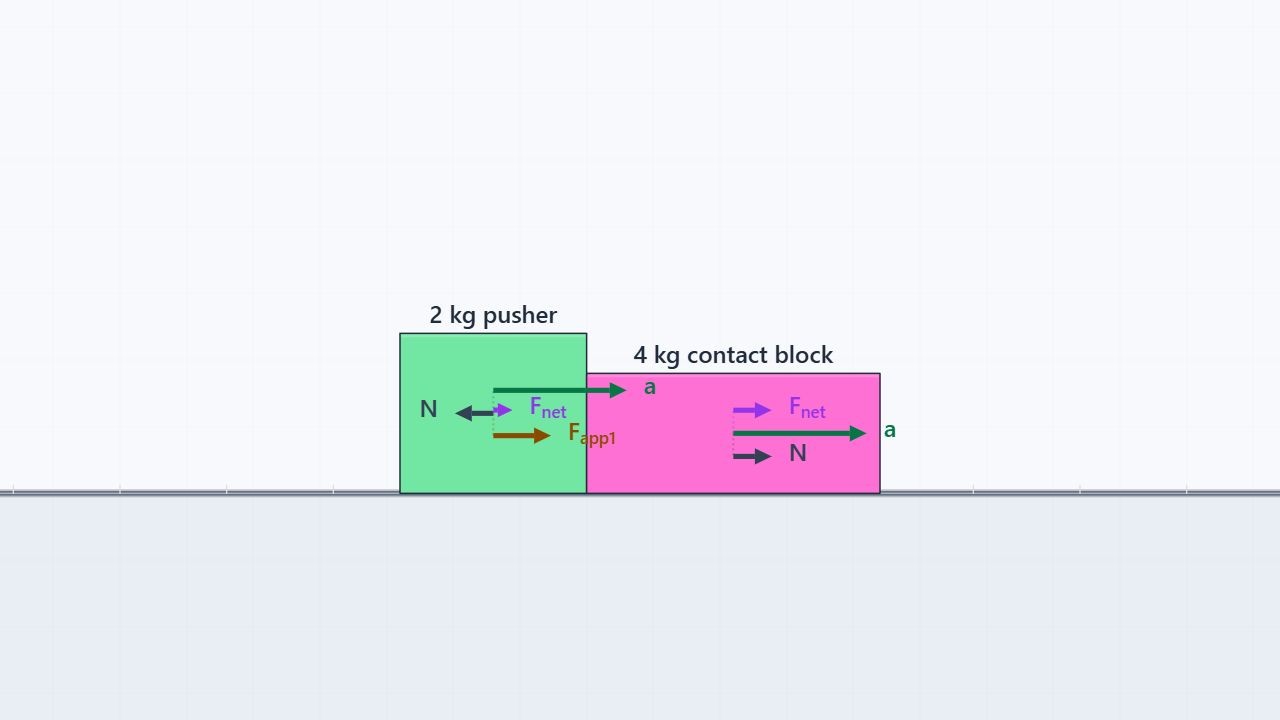
Inspect pairs of interacting objects and explain why equal and opposite forces can produce very different accelerations.

Start lesson
  • Free
  • No account required
  • Self-paced
Newton’s Third Law guided lesson preview Start guided lesson
Explore the model. Make predictions. Check your thinking.

Learn by doing

Three ideas you’ll put into motion

Find the partner force

Identify the two objects in an interaction and which force acts on each.

Compare the responses

Observe how different masses respond to equal-magnitude interaction forces.

Separate pairs from balance

Distinguish third-law partners from forces that cancel on one object.

The big idea

The key ideas, at a glance.

One interaction, two forces

If A exerts a force on B, B exerts an equal-magnitude force in the opposite direction on A. The forces act simultaneously.

Different objects have different responses

Third-law forces act on different objects. Each object’s acceleration depends on its own mass and net force.

A quick comparison

Two interacting objects have different masses.

Equal interaction forces can produce unequal accelerations.

force on Aforce on BEqual magnitude · opposite directions
Teaching this topic?Classroom fit, AP connections, and support
Classroom fit
Use for a concept introduction, guided independent practice, or a projected class discussion.
Before students begin
Force diagrams, net force, and Newton’s second law.
Built-in support
Prepared scenes, guided prompts, and feedback on lesson questions.
AP Physics 1 connections
Unit 2: Newton’s third law and interactions between systems.
Check for understanding
Ask students to name the partner to the gravitational force exerted by Earth on a book.
Optional extension
Try the Newton’s Third Law lab.
Meet the educator behind Build Physics

Ready to test your thinking?

The first scene is set up. Start the lesson and explore.

Start lesson