
Plan the investigation
Which arrows form one interaction?
Newton’s Third Law connects two forces that the same two objects exert on one another. The forces have equal magnitude, opposite direction, the same interaction type, and different target objects:
FA on B = −FB on A
|FA on B| = |FB on A|
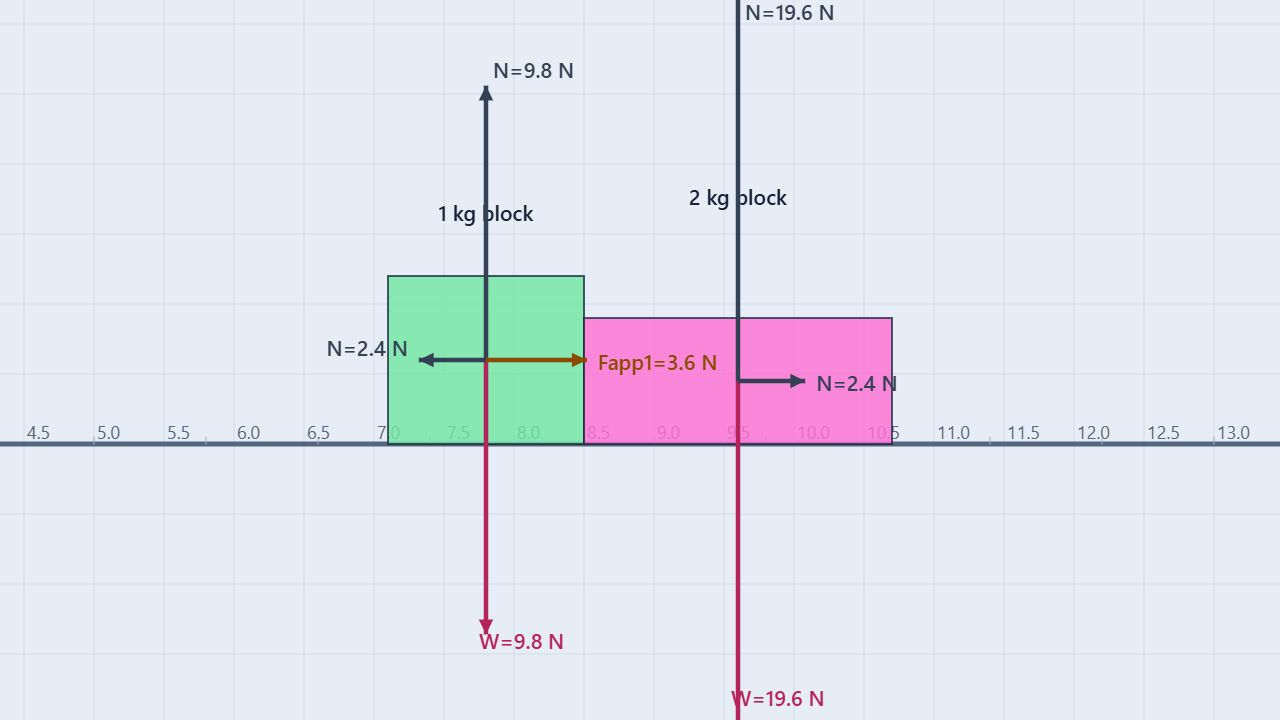
The prepared scene uses two touching blocks. A 1 kg block and a 2 kg block start together with a 3.6 N external push. Their contact forces are about 2.4 N in opposite directions, while both blocks accelerate at about 1.2 m/s². The unequal masses change the net force each block needs; they do not change the equality of the contact pair.
Change or control
Change the two masses, the external push, or the contact setup one at a time. Keep the floor and friction settings fixed while testing the pair.
Measure and compare
Select each block and compare the contact-force magnitude, direction, net force, and acceleration. Record the source and target with every value.
Read the interaction
Equal forces do not act on the same block
If the 1 kg block pushes the 2 kg block to the right, the 2 kg block pushes the 1 kg block to the left with the same magnitude. These are separate arrows on separate free-body diagrams. They do not cancel when you calculate the net force on one block.
| Check | Contact example |
|---|---|
| Same interaction | Block-on-block contact |
| Equal magnitude | 2.4 N and 2.4 N |
| Opposite direction | Right on one block, left on the other |
| Different targets | One force acts on each block |
Weight and normal force can also be equal and opposite, but they are not a Third Law pair for one block: both arrows act on the same block and come from different interactions. The partner to Earth’s pull on a block is the block’s pull on Earth. The partner to the floor’s normal force on the block is the block’s normal force on the floor.
Procedure
Run the contact-force investigation
- Load and inspect. Launch the Newton’s Third Law simulation and keep the prepared two-block scene. Confirm that the blocks are touching, friction is off, and the 1 kg and 2 kg labels are visible.
- Predict the pair. Before running, write the two contact forces with source and target: F1 kg on 2 kg and F2 kg on 1 kg. Predict equal magnitudes and opposite signs.
- Show one object at a time. Select the 1 kg block, turn on force values, and record its contact force and net force. Select the 2 kg block and record the matching contact value with the opposite direction.
- Run the trial. Let the blocks move together for at least 0.45 s. Compare both acceleration readings. The prepared scene should show about 1.2 m/s² for each block while contact is maintained.
- Change one condition. Reset, change only one mass or the external push, and repeat. Check whether the pair stays equal and opposite even when the two acceleration magnitudes become different.
- Change the system boundary. First calculate the net force on each block separately. Then treat both blocks as one system and identify which contact forces become internal and cancel from the system equation.
| Quantity | 1 kg block | 2 kg block |
|---|---|---|
| Contact force | 2.4 N left | 2.4 N right |
| Acceleration | 1.2 m/s² right | 1.2 m/s² right |
| Target of the partner force | 2 kg block | 1 kg block |
Worked example
Separate the system equation from each block equation
For a more visible contact trial, imagine a 2 kg pusher and a 4 kg block receiving a 12 N external push to the right. Treat both blocks as one system first:
msys = 2 kg + 4 kg = 6 kg
asys = Fexternal/msys = 12 N/6 kg = 2 m/s² right
For the 4 kg block, the pusher’s contact force must provide its horizontal net force:
Fpusher on block = mblockablock = (4 kg)(2 m/s²) = 8 N right
Fblock on pusher = 8 N left
For the 2 kg pusher, include both the 12 N external push and the 8 N contact force:
ΣFpusher,x = 12 N − 8 N = 4 N right
apusher = 4 N/2 kg = 2 m/s² right
The contact forces disappear from the combined-system equation because they are internal. They remain essential when you analyze either block by itself.
Force versus response
Equal interaction forces can produce unequal accelerations
Newton’s Third Law fixes the force magnitudes. Newton’s Second Law determines the response of each target object:
a = ΣF/m
A 2 kg exhaust packet and a 6 kg rocket can exert opposite 12 N forces on one another. The packet accelerates at 6 m/s² while the rocket accelerates at 2 m/s². The different accelerations show different masses, not unequal interaction forces. The same reasoning explains why a small car can have a much larger acceleration than a heavy truck during a collision.
| Object | Mass | Force magnitude | Acceleration magnitude |
|---|---|---|---|
| Exhaust packet | 2 kg | 12 N | 6 m/s² |
| Rocket | 6 kg | 12 N | 2 m/s² |
Pair or balance?
Use the target-object test
Ask “what object receives this arrow?” before deciding whether two vectors belong in one net-force equation. Forces balance on one selected object when their vector sum is zero. Third-law partners connect two different target objects.
| Situation | Third-law pair | Possible balance on one object |
|---|---|---|
| Block on floor | Earth on block / block on Earth | Weight and floor normal on the block |
| Two blocks in contact | Pusher on block / block on pusher | Other forces on one block may balance |
| Rocket propulsion | Rocket on exhaust / exhaust on rocket | External forces on the rocket may balance separately |
| Walking | Foot on Earth / Earth on foot | Other forces can balance on the person |
When both blocks are selected as one system, the contact pair is internal and cancels in the system sum. That cancellation follows from the chosen boundary; it does not mean the pair acted on the same block.
Common misconceptions
Check the reasoning
Does the heavier object exert the larger contact force?
No. The two objects exert equal-magnitude, opposite-direction forces on one another. Mass can change acceleration, not the Third Law equality.
Do action and reaction happen one after the other?
No. They are simultaneous members of one interaction.
Do equal and opposite forces cancel on an individual free-body diagram?
No. The pair acts on different objects. It cancels only when the system includes both targets and the equations are added.
Are weight and normal force a Third Law pair?
No. For a resting block, both may act on the block and balance. Their partners act on Earth and the floor.
Do equal forces mean equal accelerations?
No. Calculate a = F/m for each object. Equal masses give equal acceleration magnitudes; unequal masses do not.
For teachers
Make every arrow answer two questions
Ask students to label each force as “source on target” before adding vectors. Start with the 1 kg and 2 kg prepared scene, have students draw separate free-body diagrams, and then redraw both blocks as one system so the internal cancellation has a visible reason.
Use the 2 kg and 4 kg, 12 N example to connect the pair to measurable acceleration. Finish with the glass, rocket, fly, and walking examples so students practice matching interaction type and target object instead of memorizing an arrow pattern.
Continue with Free-Body Diagrams for system boundaries, Newton’s Second Law for acceleration responses, and the Newton’s Third Law guide for more interaction-pair examples.