Identify the force pair
Name which object exerts each force and which receives it. Separate interaction partners from forces that happen to balance on one object.
 BuildPhysics
AP Physics 1 · Unit 2, Part 1 · Forces
Identify the two objects in an interaction and calculate how connected or touching objects accelerate. Practice contact pushes, strings, several blocks, and thrust without surrounding air.
12 questions6 conceptual · 6 calculation
Start practiceFree · No account required · Self-paced
 Open interactive practice
What you’ll practice
Name which object exerts each force and which receives it. Separate interaction partners from forces that happen to balance on one object.
Use each object’s mass and full net force to explain how equal interaction forces can produce different motion.
Analyze two and three touching blocks, a cord pulling a middle block, a crate on a platform, and a short thrust interval.
A question from this set
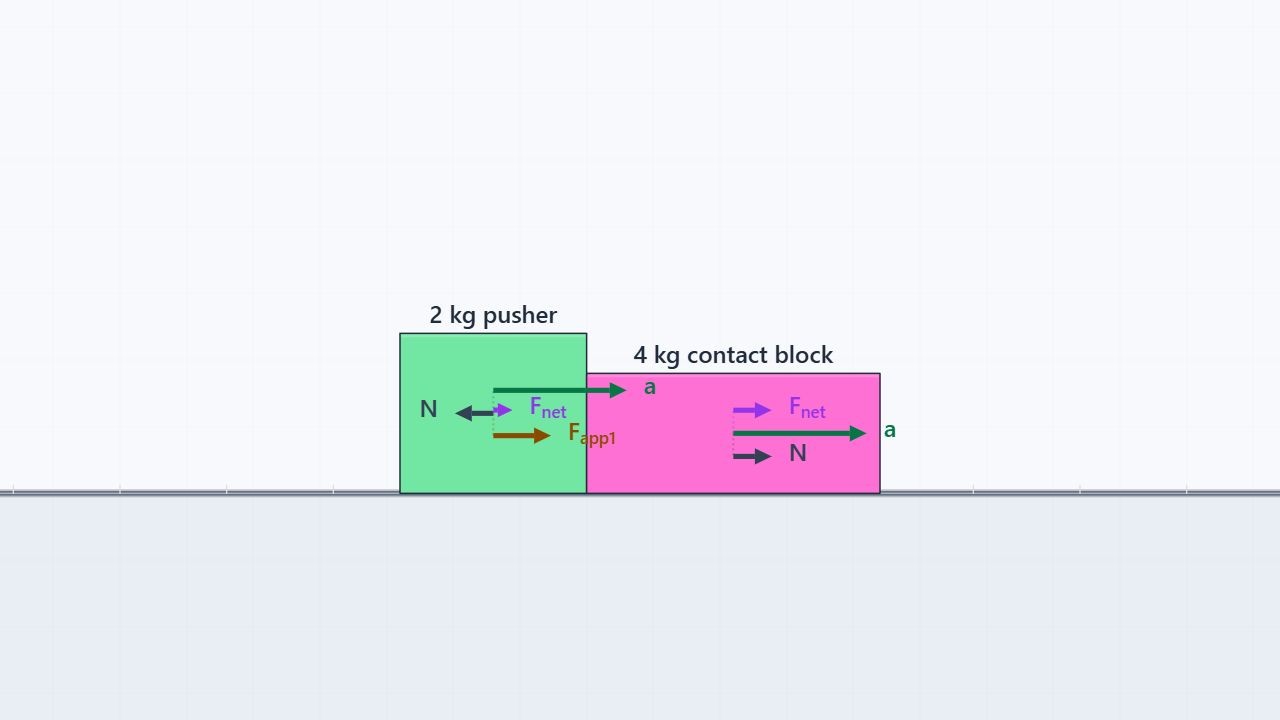
Block 1 pushes block 2 to the right as two touching blocks accelerate along a frictionless track. Which force is the third-law partner of that contact push?
Try it in the practice setKey ideas
If block 1 pushes block 2, its partner is block 2 pushing block 1. Both forces belong to the same contact interaction and exist together.
Contact forces between included blocks cancel in the whole-system equation. To find a particular contact force, isolate a block or smaller collection.
See the physics
Check your response, then watch interacting blocks move together. Compare the opposite contact arrows and use individual objects to check a force calculated from the system acceleration.
Use a hint for a starting point or open a worked solution to follow the reasoning. Your progress saves in this browser, so you can return to unfinished questions.
Begin with a conceptual question, then work through the calculations.