Change the application point
Compare the same force applied near and far from a chosen pivot.
 BuildPhysics
AP Physics 1 · Unit 5 · Torque and Rotational Dynamics
Move a force along a lever, change its angle, and measure how force, distance, and direction affect the turning effect.
Start lesson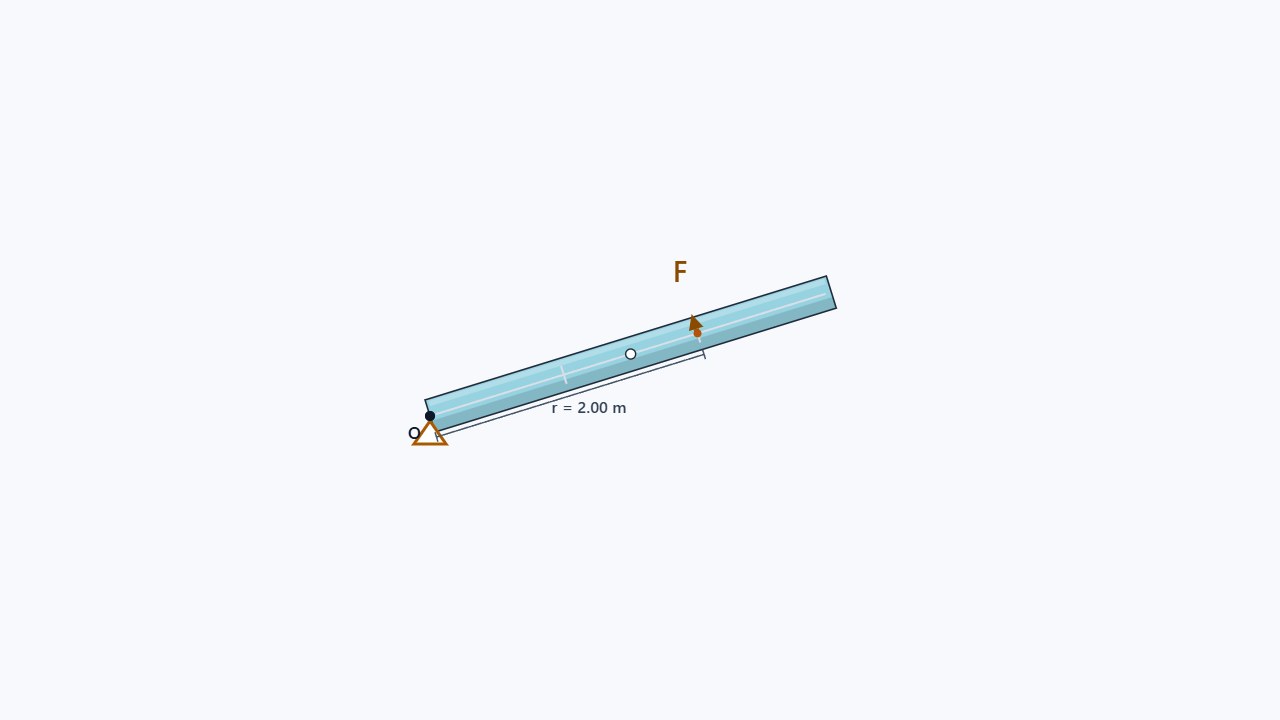 Start guided lesson
Learn by doing
Compare the same force applied near and far from a chosen pivot.
Use the perpendicular force component or perpendicular lever arm to calculate torque.
Assign clockwise and counterclockwise signs, then test a target net torque.
The big idea
Torque magnitude is τ = rF sin θ, where θ is the angle between the position vector and force. The pivot must be specified.
Equivalently, τ = Fd⊥. A force whose line of action passes through the pivot produces zero torque about that pivot.
A quick comparison
Keep a perpendicular force fixed and double its distance from the pivot.
Torque magnitude doubles.
The first scene is set up. Start the lesson and explore.