Connect force, distance, and angle
Compare a push at a door’s center with one at its outer edge. Find the force needed for a target torque and use the angle between the position vector and force, rather than an unrelated diagram angle.
 BuildPhysics
AP Physics 1 · Unit 5 · Rotation
Work from a force diagram to its turning effect about a named axis. Compare door pushes, resolve an angled fishing-line pull, add three wheel torques, change a beam’s pivot, and calculate gravity torque on a pendulum.
13 questions6 conceptual · 7 calculation
Start practiceFree · No account required · Self-paced
 Open interactive practice
What you’ll practice
Compare a push at a door’s center with one at its outer edge. Find the force needed for a target torque and use the angle between the position vector and force, rather than an unrelated diagram angle.
Assign clockwise and counterclockwise signs before adding wheel torques. Calculate the same three beam forces about two axes and identify which forces have zero moment about each one.
Use either rF sin θ or Fd for a fishing rod and a small mounting tab. For a pendulum, identify the horizontal lever arm of its vertical weight and keep the angle measured from vertical.
A question from this set
The same perpendicular force is applied to a rigid door first at distance r from its hinge, then at distance 2r. What happens to the torque magnitude about the hinge?
Try it in the practice setKey ideas
The perpendicular distance from the pivot to the force’s line of action determines the turning effect. A large force can produce zero torque when that line passes through the pivot.
Equal opposite forces can form a couple with zero net force and nonzero torque. Moving the reference axis can change a force’s moment arm and even reverse its torque sign.
See the physics
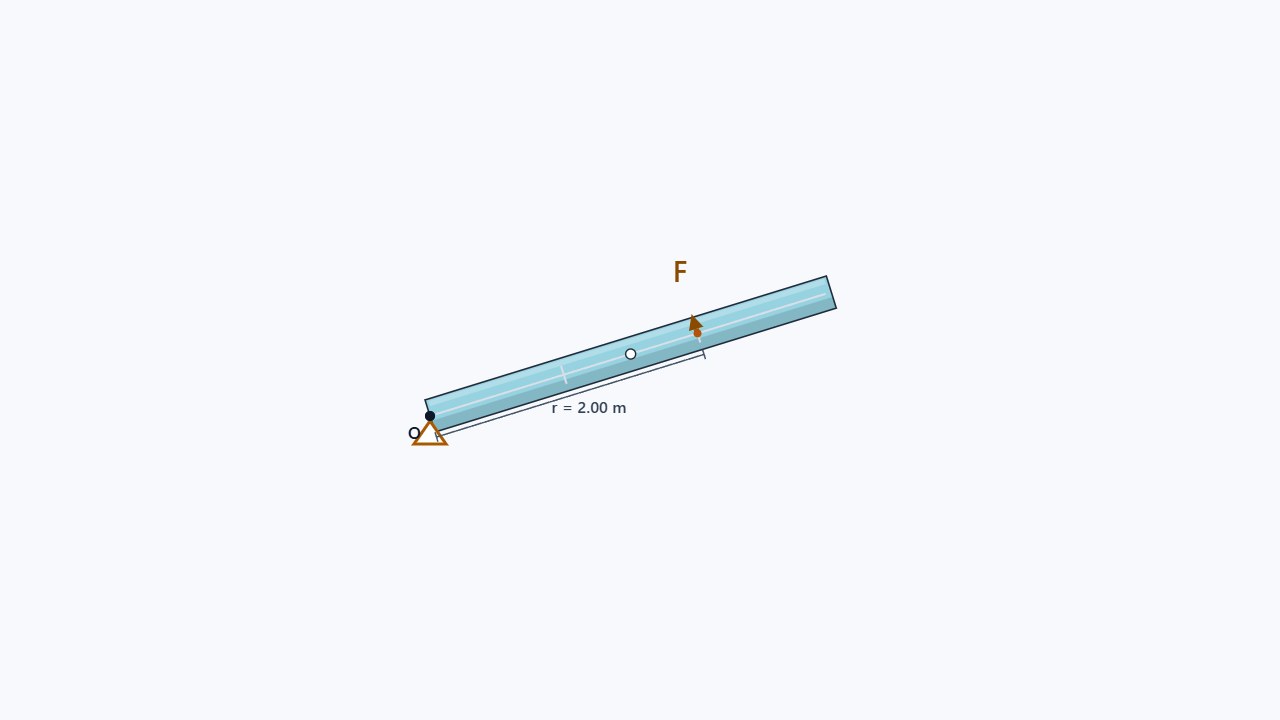
After attempting a question, run the prepared bar, wheel, or pendulum. Compare each force’s starting moment with the recorded net torque, switch beam pivots, and inspect the changing torque when a fixed-direction force acts on a rotating bar. A magnified view keeps the mounting tab’s centimeter-scale geometry visible.
Use a hint for a starting point or open a worked solution to follow the reasoning. Your progress saves in this browser, so you can return to unfinished questions.
Begin with a conceptual question, then work through the calculations.