Check the external impulse
Explain why taking a step changes one person’s momentum and how the ground belongs in a larger system. Distinguish internal transfers from an outside impulse.
 BuildPhysics
AP Physics 1 · Unit 4 · Momentum
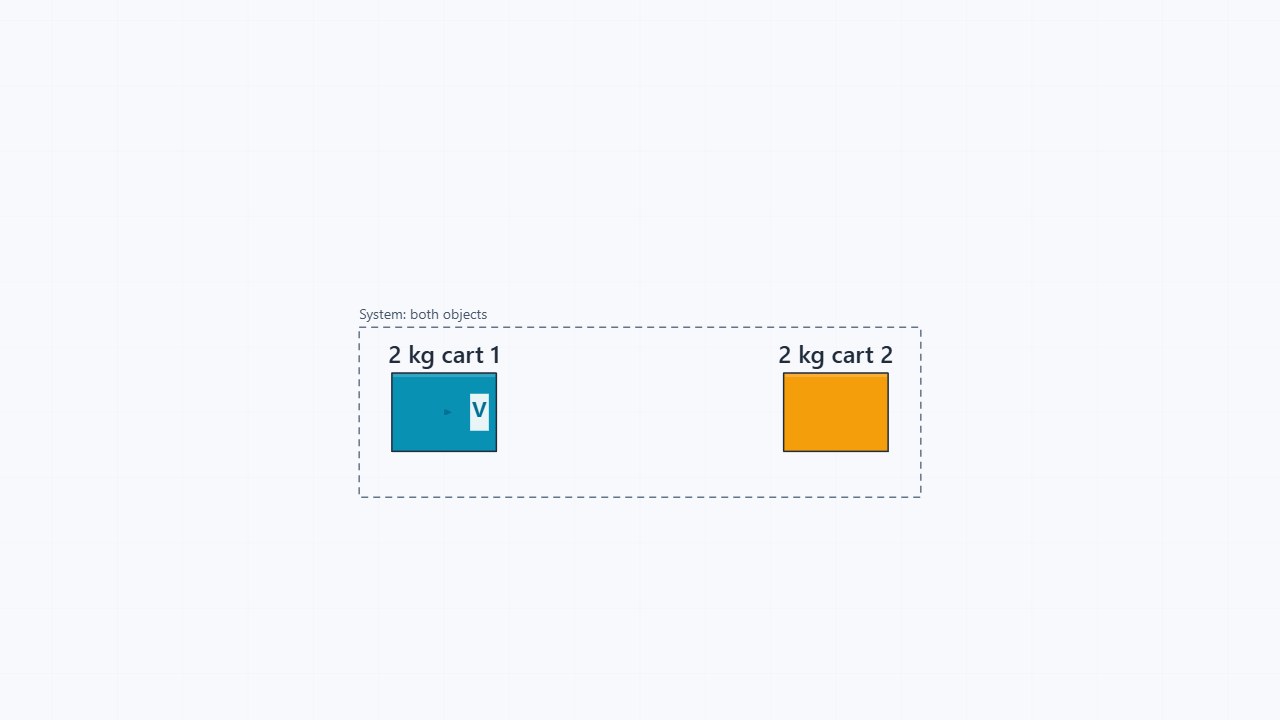
Choose the objects in your system, then track momentum through collisions and releases. Practice carts that stick, a moving thrower and catcher, vehicle impacts, spring recoil, and modules separating in two directions.
12 questions6 conceptual · 6 calculation
Start practiceFree · No account required · Self-paced
 Open interactive practice
What you’ll practice
Explain why taking a step changes one person’s momentum and how the ground belongs in a larger system. Distinguish internal transfers from an outside impulse.
Add the initial momentum of every object. Solve a sequence of sticking collisions, a moving throw, a catch, and different occupant velocity changes during a vehicle impact.
Compare spring forces on unequal masses, calculate opposite recoil velocities, and conserve x and y momentum independently during a planar release.
A question from this set
A person initially at rest takes a step to the right on level ground. Does the person’s new momentum contradict conservation of momentum?
Try it in the practice setKey ideas
Equal and opposite internal impulses cancel in the complete system. The individual objects can change momentum while the system total remains constant when net external impulse is zero.
For objects that remain together, add their masses in the final momentum term. Momentum can stay constant while kinetic energy becomes internal energy. A spring release can instead increase kinetic energy using stored energy.
See the physics
After checking an answer or calculation parts, run the prepared collision or release. Compare recorded momentum traces for each object with the system total, switch the three-cart collision order, and examine separate component graphs for a planar release.
Use a hint for a starting point or open a worked solution to follow the reasoning. Your progress saves in this browser, so you can return to unfinished questions.
Begin with a conceptual question, then work through the calculations.