Keep the direction in momentum
Use mass and velocity to calculate momentum components. Compare the highest point of a throw with its rising and falling passes through one height.
 BuildPhysics
AP Physics 1 · Unit 4 · Momentum
Connect momentum vectors with the force acting over time. Practice vertical throws, force pulses, glancing rebounds, impact buffers, and a puck struck back in the opposite direction.
12 questions6 conceptual · 6 calculation
Start practiceFree · No account required · Self-paced
 Open interactive practice
What you’ll practice
Use mass and velocity to calculate momentum components. Compare the highest point of a throw with its rising and falling passes through one height.
Find area under a force–time curve, including regions below the time axis. Add the net impulse to the initial momentum to find the final velocity.
Resolve a glancing collision perpendicular and parallel to a wall. Connect a stopping distance or a short contact interval with the average force.
A question from this set
Two survey carts move right at the same velocity. Cart B has twice the mass of cart A. How does B’s momentum compare with A’s?
Try it in the practice setKey ideas
For a constant mass, p = mv and Δp = m(vf − vi). Reversing motion can produce a large momentum change even when the speed is unchanged.
The area under the net force–time curve gives impulse. A longer stopping interval reduces average force when the required momentum change stays the same. Regions below the time axis contribute negatively.
See the physics
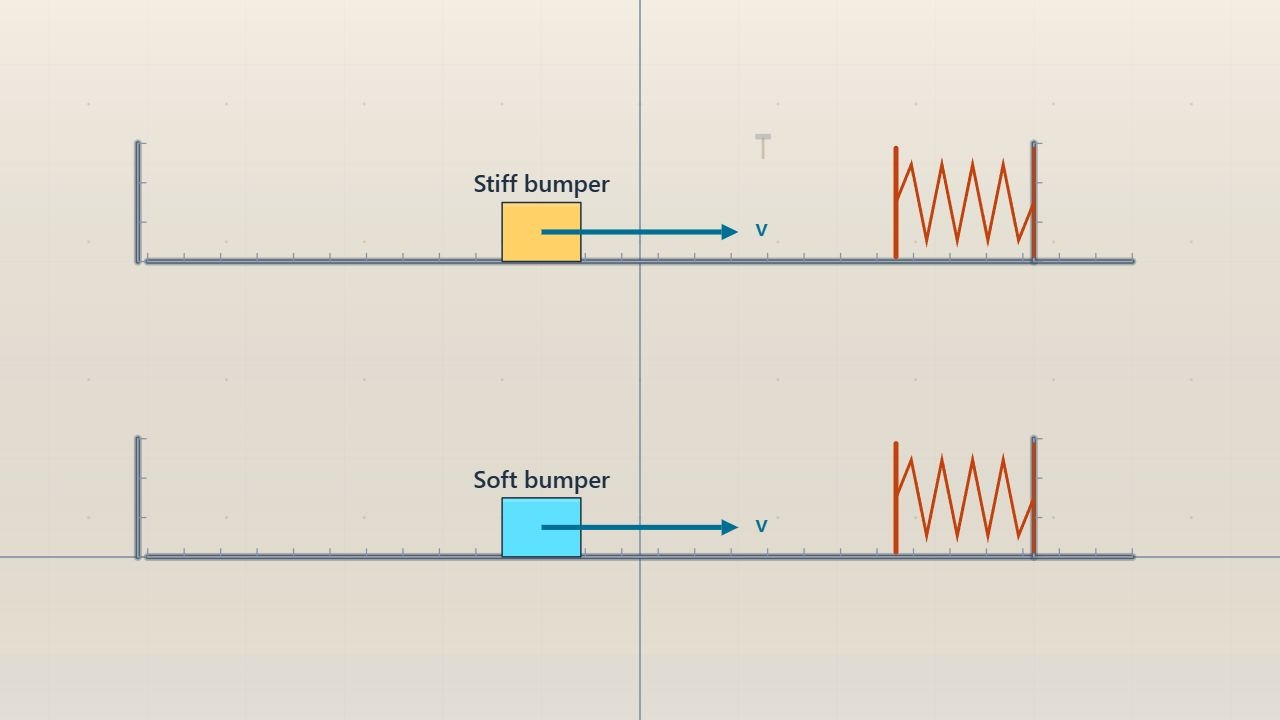
After checking your answer or calculation parts, run the prepared scene. Compare impulse with the measured momentum change, switch pulse or stopping trials, and inspect recorded momentum–time graphs. Short contact intervals use milliseconds on the graph.
Use a hint for a starting point or open a worked solution to follow the reasoning. Your progress saves in this browser, so you can return to unfinished questions.
Begin with a conceptual question, then work through the calculations.