Compare paths with shared endpoints
Calculate gravity’s work for different ramps and compare friction on a direct route and a detour. Interpret a complete return route.
 BuildPhysics
AP Physics 1 · Unit 3 · Energy
Compare work along different routes and choose a reference for potential energy. Practice gravity on ramps, friction along detours, closed routes, and mechanical energy transferred to thermal energy.
12 questions6 conceptual · 6 calculation
Start practiceFree · No account required · Self-paced
 Open interactive practice
What you’ll practice
Calculate gravity’s work for different ramps and compare friction on a direct route and a detour. Interpret a complete return route.
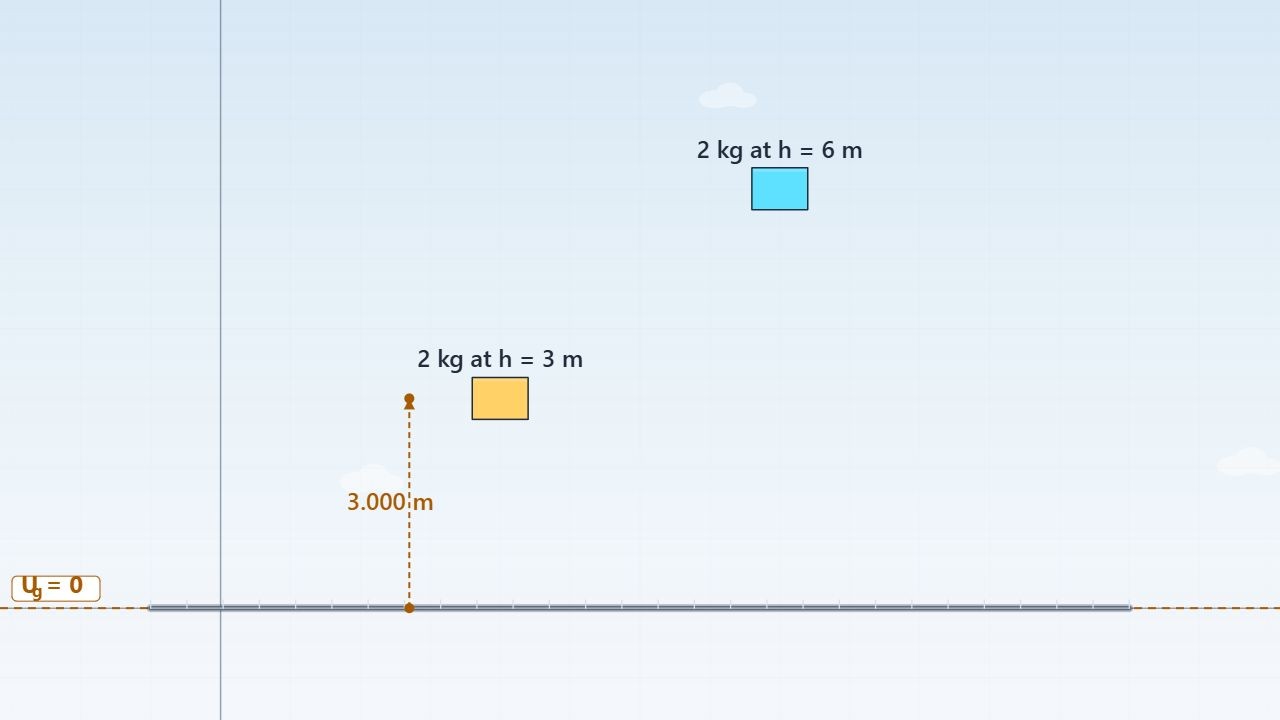
Calculate gravitational potential energy from a chosen zero and show how a reference shift affects values without changing the physical energy difference.
Connect gravity’s work with potential energy and account for friction on a rough ramp. Distinguish a fixed force vector from a pull that follows the direction of travel.
A question from this set
Identical crates descend two frictionless ramps from the same starting height to the same finishing height. One ramp is long and shallow; the other is shorter and steeper. How does the work done by gravity compare?
Try it in the practice setKey ideas
Near Earth, Wgravity = −ΔUg. For fixed endpoints, a longer route does not by itself change gravitational work. A closed route returns to the same gravitational potential energy.
Sliding friction removes mechanical energy over the traveled path. A detour can increase this transfer even when initial and final heights remain the same.
See the physics
After checking an answer, compare the prepared ramps or detours. Inspect gravity work, friction work, and potential-energy changes while keeping track of the shared endpoints.
Use a hint for a starting point or open a worked solution to follow the reasoning. Your progress saves in this browser, so you can return to unfinished questions.
Begin with a conceptual question, then work through the calculations.