Determine the work of each force
Use force magnitude, displacement, and the angle between them. Identify zero work when displacement is zero or the force is perpendicular to motion.
 BuildPhysics
AP Physics 1 · Unit 3 · Energy
Calculate work by individual forces and relate net work to a change in kinetic energy. Practice lifts, steady towing, braking, angled pushes, and carts that are already moving.
12 questions6 conceptual · 6 calculation
Start practiceFree · No account required · Self-paced
 Open interactive practice
What you’ll practice
Use force magnitude, displacement, and the angle between them. Identify zero work when displacement is zero or the force is perpendicular to motion.
Find a speed change from net work or calculate the resisting force needed to stop an object. Include its initial kinetic energy.
Account for motor pulls, friction, gravity, and angled pushes. Explain how positive and negative individual work can sum to zero.
A question from this set
Two people pull equally hard in opposite horizontal directions on a crate, and the crate does not move. During this interval, how much mechanical work does each pulling force do on the crate?
Try it in the practice setKey ideas
The angle is between the force and displacement. A force along the motion does positive work; an opposing force does negative work.
Add the work of all forces to find ΔK. Kinetic energy is ½mv², so doubling speed multiplies kinetic energy by four.
See the physics
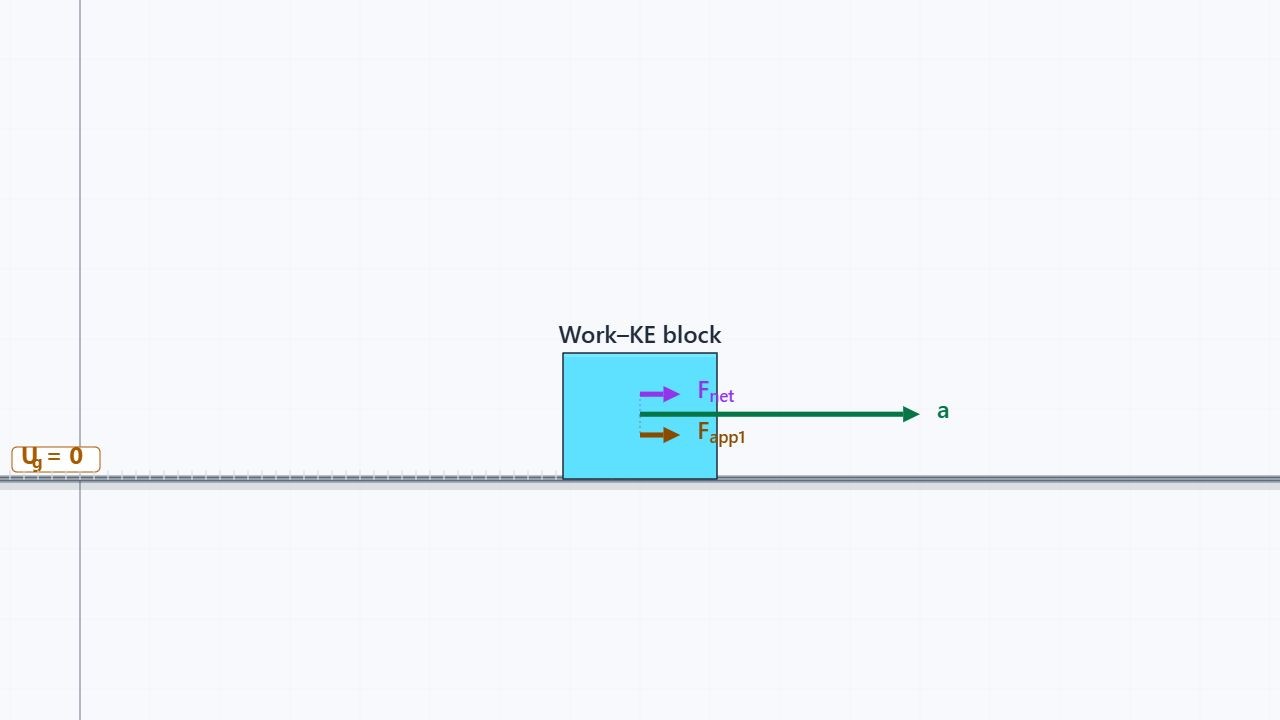
Check your response, then run a lift, tow, brake, or balanced-pull scene. Compare each force’s work and the net kinetic-energy change with the values you calculated.
Use a hint for a starting point or open a worked solution to follow the reasoning. Your progress saves in this browser, so you can return to unfinished questions.
Begin with a conceptual question, then work through the calculations.