Compare paths through the same height change
Predict final speed for free fall, straight ramps, and curved tracks under the stated ideal conditions. Distinguish a speed comparison from an arrival-time comparison.
 BuildPhysics
AP Physics 1 · Unit 3 · Energy
Use mechanical energy to find speeds and heights on drops, ramps, curved tracks, swings, and projectile flights. Compare ideal motion with a swing that loses mechanical energy.
12 questions6 conceptual · 6 calculation
Start practiceFree · No account required · Self-paced
 Open interactive practice
What you’ll practice
Predict final speed for free fall, straight ramps, and curved tracks under the stated ideal conditions. Distinguish a speed comparison from an arrival-time comparison.
Use initial motion and changes in height to find a speed or height. Retain horizontal kinetic energy at the peak of an angled projectile.
Compare an ideal swing with a resisted swing and use the mechanical-energy difference to quantify the loss.
A question from this set
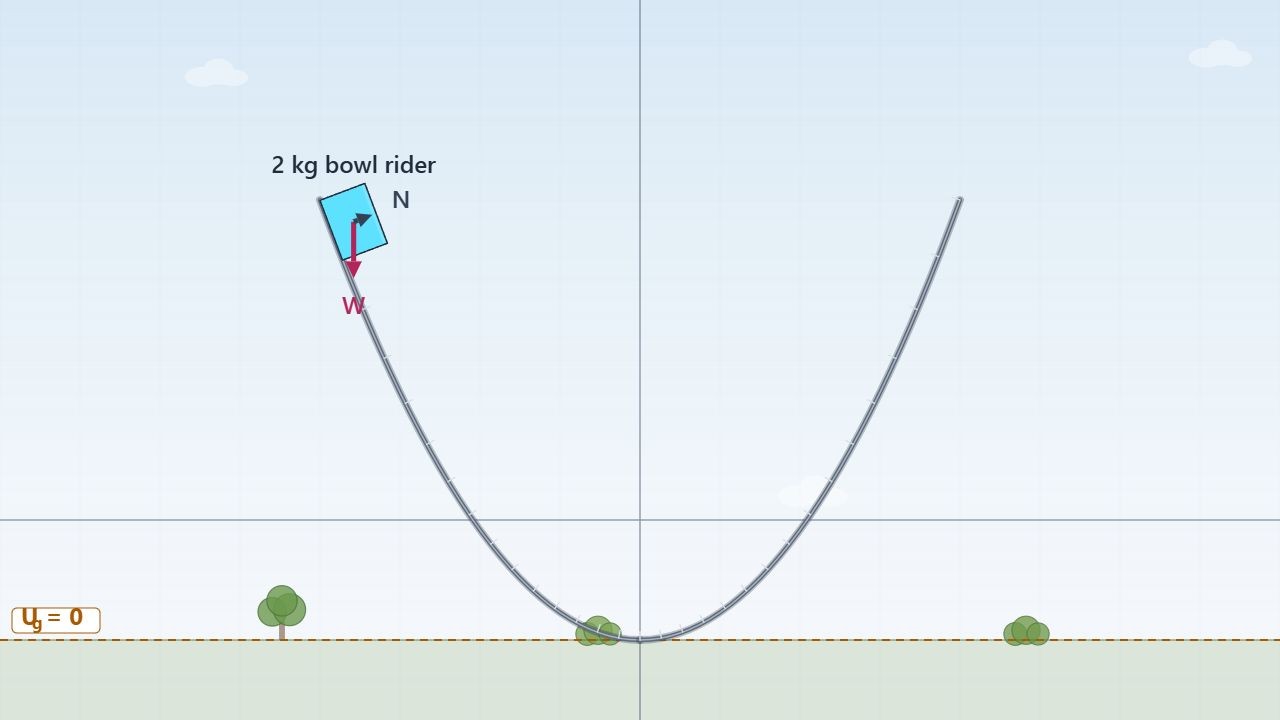
Three identical sliders start from rest and descend through the same vertical height: one in free fall, one on a frictionless straight ramp, and one on a frictionless curved track. Ignore air resistance and rotation. How do their speeds compare at the lower height?
Try it in the practice setKey ideas
For these ideal gravity-driven motions, kinetic plus gravitational potential energy stays constant. A decrease in Ug can become an increase in K.
Equal vertical drops from identical initial conditions give equal final speeds when no mechanical energy is lost. That result does not require identical travel times.
See the physics
Check your result, then switch between the prepared drop, straight-ramp, and curved-track trials. Inspect the speed at a marker or compare an ideal swing’s energy with a resisted swing.
Use a hint for a starting point or open a worked solution to follow the reasoning. Your progress saves in this browser, so you can return to unfinished questions.
Begin with a conceptual question, then work through the calculations.