Separate path from position change
Find distance and displacement for a trip with a reversal. Use initial and final coordinates, including positions on either side of zero.
 BuildPhysics
AP Physics 1 · Unit 1 · Kinematics
Work out how far an object travels, where it ends up, and how fast its position changes. Practice with one-way journeys, return trips, and stops along the way.
12 questions6 conceptual · 6 calculation
Start practiceFree · No account required · Self-paced
 Open interactive practice
What you’ll practice
Find distance and displacement for a trip with a reversal. Use initial and final coordinates, including positions on either side of zero.
Find average speed and average velocity using the full journey time. Include pauses and account for different speeds on different legs.
Explain why a cart can be left of the origin and still have positive velocity. Compare trips with the same average but different motion along the way.
A question from this set
A cart travels 7 m right, then 3 m left along the same straight track. How does the total distance compare with the magnitude of its displacement?
Try it in the practice setKey ideas
Add every leg’s length to find distance. For displacement, subtract the initial position from the final position: Δx = xf − xi. Returning to the start gives zero displacement, even after a long journey.
Average speed is total distance divided by total elapsed time. Average velocity is displacement divided by that same time. A delivery stop adds time without adding distance. Simply averaging two speeds can give the wrong whole-trip answer.
See the physics
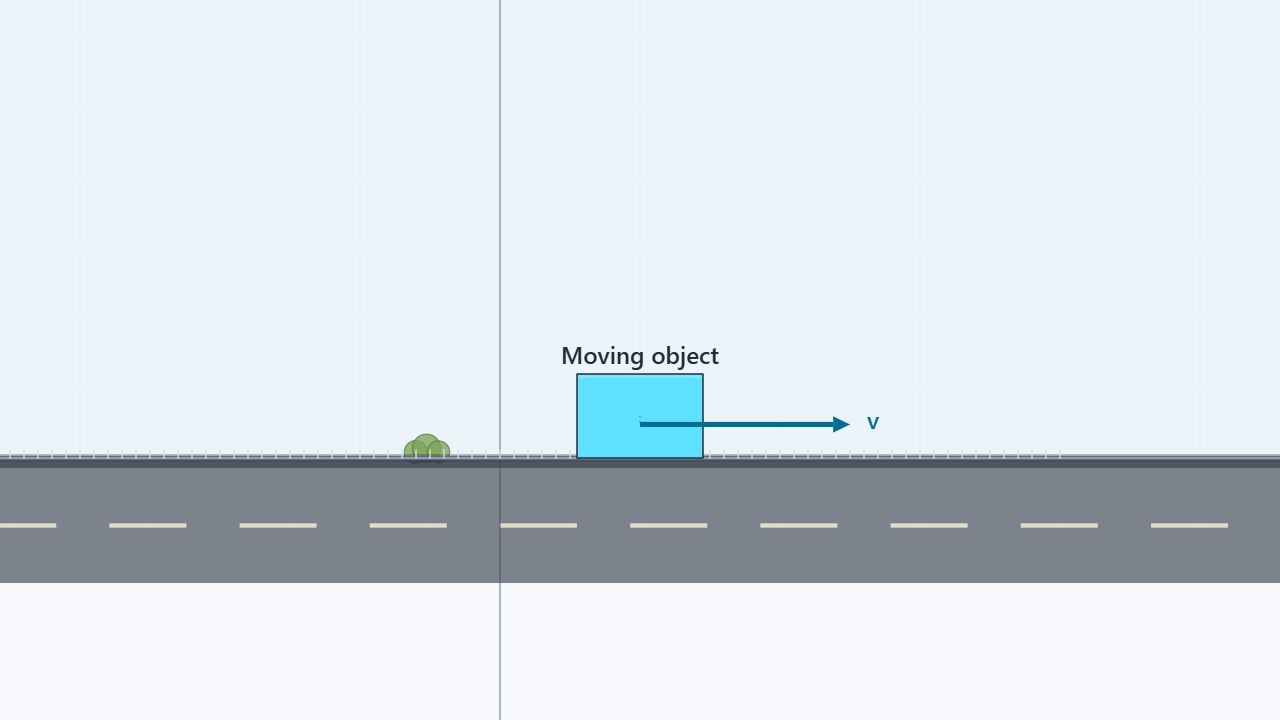
After checking an answer—or each part of a calculation—run the prepared scene. Follow the cart, compare its route with its start and finish, and inspect the numerical motion values. Other questions let you compare coordinate origins or two rovers with the same whole-trip average.
Use a hint when you need a starting point, or open a worked solution to follow the reasoning. Your progress saves in this browser, so you can return to unfinished questions.
Start with a short conceptual question, then work through the calculations.