Read the ellipse
Locate the central mass at a focus and compare near and far parts of the orbit.
 BuildPhysics
AP Physics 1 · Unit 6 · Energy and Momentum of Rotating Systems
Trace an elliptical orbit, compare equal-time swept areas, and explain changing orbital speed with gravitational potential and kinetic energy. Finish with a five-question conceptual review.
Start lesson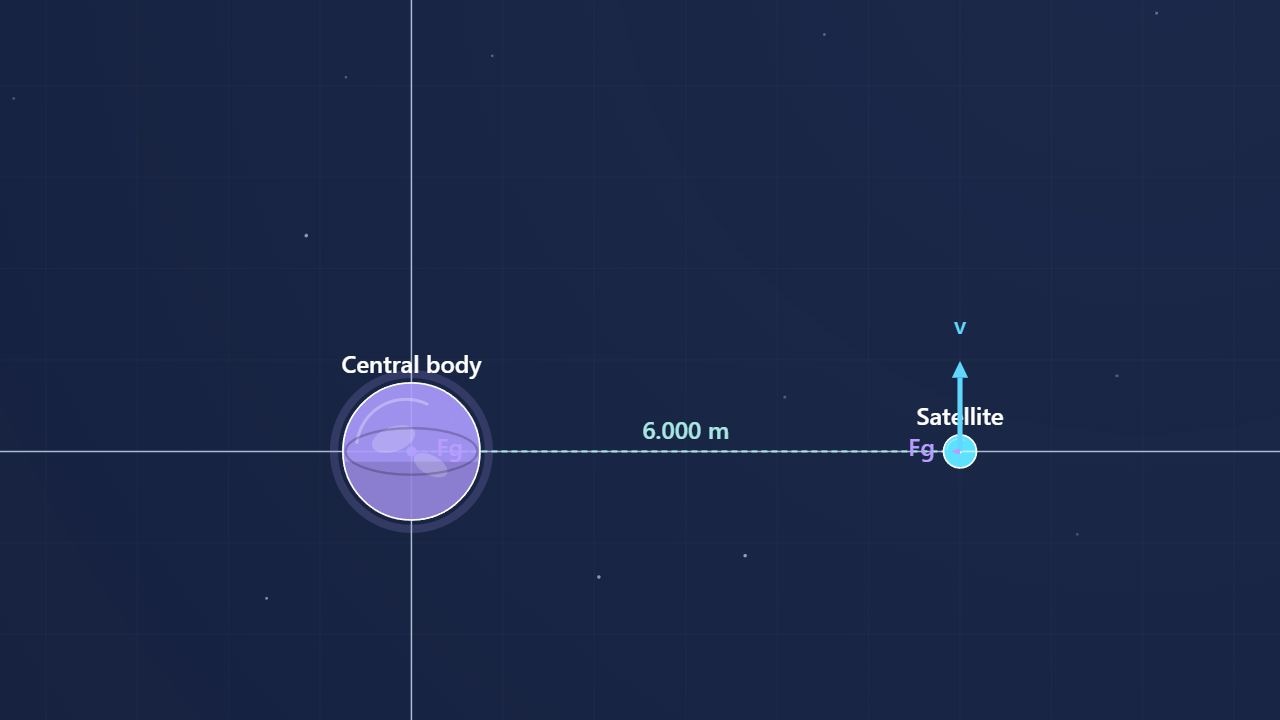 Start guided lesson
Learn by doing
Locate the central mass at a focus and compare near and far parts of the orbit.
Observe swept areas to connect an orbit’s geometry with changing speed.
Track kinetic and gravitational potential energy, then explore the escape condition.
The big idea
For an ideal bound orbit, the satellite moves faster near the central mass and slower farther away. Equal-time intervals sweep equal areas.
With zero potential at infinity, U = −GMm/r. In an isolated ideal orbit, kinetic and potential energy change while their sum stays constant.
A quick comparison
Compare the near and far points of the same bound orbit.
Nearer: fasterFarther: slower
The first scene is set up. Start the lesson and explore.