Find force and acceleration from position
Use signed displacement from natural length in Fs = −kx, then apply Newton’s second law. Distinguish zero acceleration at equilibrium from zero speed at a turning point.
 BuildPhysics
AP Physics 1 · Unit 7 · Oscillations
Use restoring force and energy to predict a spring–cart system’s motion at different positions.
12 questions6 conceptual · 6 calculation
Start practiceFree · No account required · Self-paced
 Open interactive practice
What you’ll practice
Use signed displacement from natural length in Fs = −kx, then apply Newton’s second law. Distinguish zero acceleration at equilibrium from zero speed at a turning point.
Use the conserved kinetic-plus-elastic energy to find maximum speed and speeds at compressed or stretched positions. Locate both positions associated with a given speed fraction.
Compare kinetic and elastic energy against position, and add gravitational potential energy for a cart attached to a spring on an incline. Keep the height reference consistent.
A question from this set
A cart attached to a horizontal spring is left of its natural-length position and is momentarily moving farther left. Which way do its spring force and acceleration point?
Try it in the practice setKey ideas
The square in Us = ½kx² makes elastic energy the same at +x and −x. At those two positions a horizontal oscillator has the same speed, while its restoring accelerations point in opposite directions.
Elastic energy curves upward with x², kinetic energy curves downward within the allowed positions, and their sum remains constant. These plots compare energy at locations; sinusoidal motion-versus-time graphs are outside this set.
See the physics
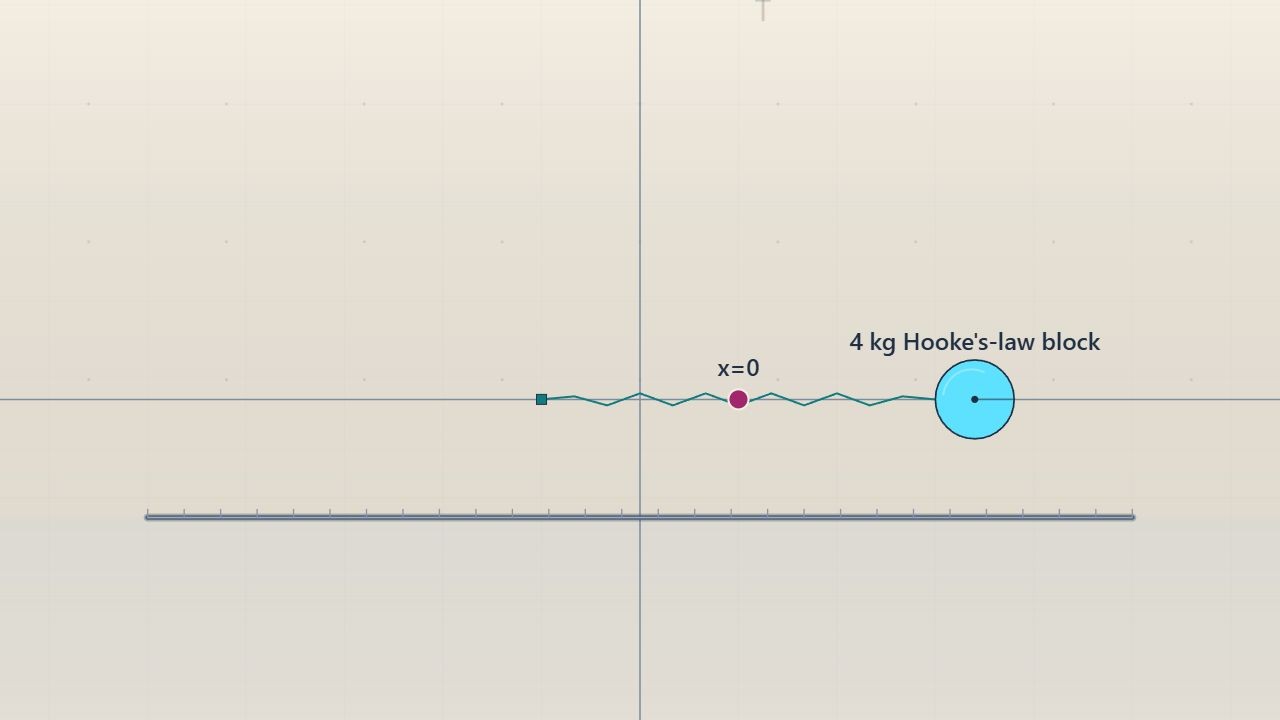
After an attempt, release an attached cart under native spring forces and inspect measured crossings and turning points. Compare both sides of equilibrium, change the release distance, and follow an inclined cart through equally spaced markers. Energy bars and energy-versus-position plots reveal how the energy is shared.
Use a hint for a starting point or open a worked solution to follow the reasoning. Your progress saves in this browser, so you can return to unfinished questions.
Begin with a conceptual question, then work through the calculations.