Recognize the SHM force condition
Check that the net force points toward equilibrium and is proportional to displacement from it. Distinguish linear SHM from a merely restoring nonlinear force.
 BuildPhysics
AP Physics 1 · Unit 7 · Oscillations
Connect restoring force to the timing, equations, and graphs of a repeating oscillation.
12 questions6 conceptual · 6 calculation
Start practiceFree · No account required · Self-paced
 Open interactive practice
What you’ll practice
Check that the net force points toward equilibrium and is proportional to displacement from it. Distinguish linear SHM from a merely restoring nonlinear force.
Convert between cycles and radians, use mass and stiffness to predict period, and calibrate a spring from a hanging mass before calculating motion with a replacement mass.
Choose a sine or cosine starting state, calculate force at a stated time, and identify velocity and acceleration extrema from a sensor trace. Compare a phase change with a change in mass.
A question from this set
Which two properties must the net restoring force have for one-dimensional simple harmonic motion about equilibrium?
Try it in the practice setKey ideas
Velocity is the slope of a position–time curve. The steepest falling crossing gives maximum negative velocity; the steepest rising crossing gives maximum positive velocity. Acceleration is opposite to displacement for the ideal linear spring.
Sine and cosine traces can represent the same mass and spring with different clock origins or initial states. Increasing mass by a factor of four doubles the period, while changing amplitude alone leaves the ideal linear-spring period unchanged.
See the physics
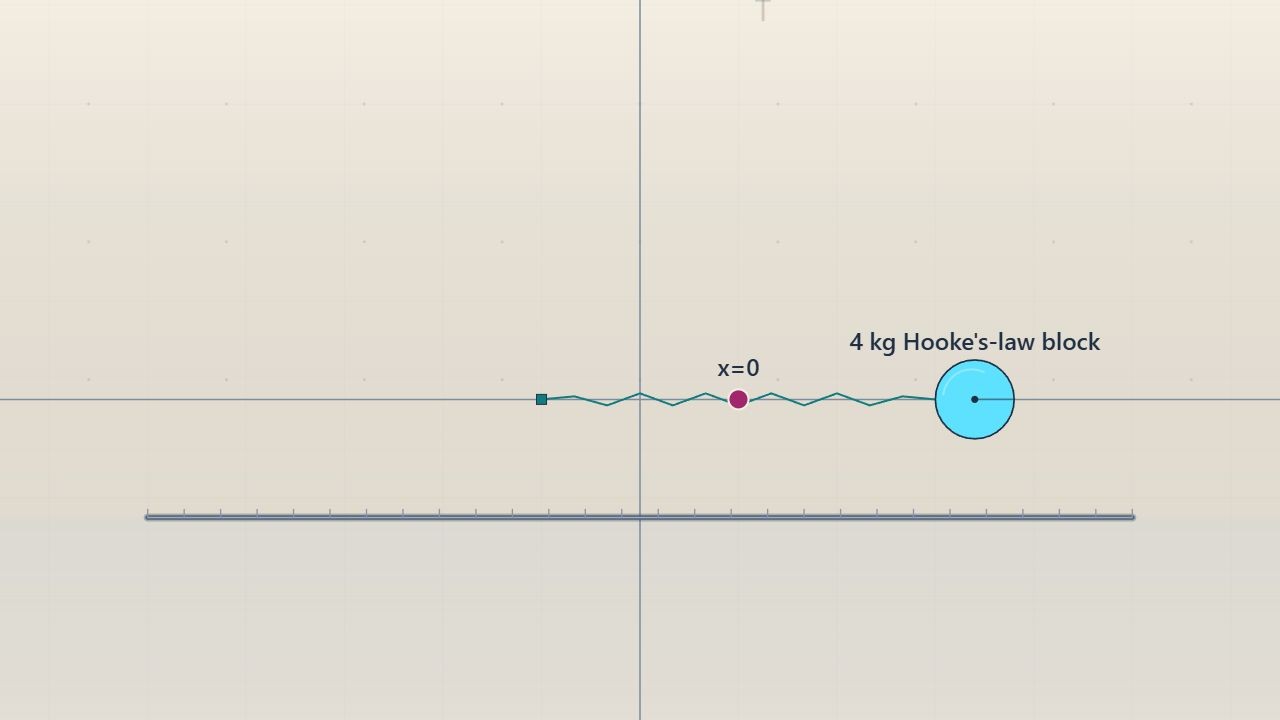
After an attempt, run the actual spring–mass model and inspect recorded displacement, velocity, and acceleration versus time. Measure a full period between repeated same-direction crossings, compare mass and amplitude changes, and test a vertical spring about loaded equilibrium. Given sensor graphs remain available before the run.
Use a hint for a starting point or open a worked solution to follow the reasoning. Your progress saves in this browser, so you can return to unfinished questions.
Begin with a conceptual question, then work through the calculations.