BuildPhysics

AP Physics 1 · Unit 3 · Work, Energy, and Power

Hooke’s Law and Elastic Potential Energy

Stretch and compress a spring, compare restoring forces, and use elastic potential energy to predict motion.

Start lesson
  • Free
  • No account required
  • Self-paced
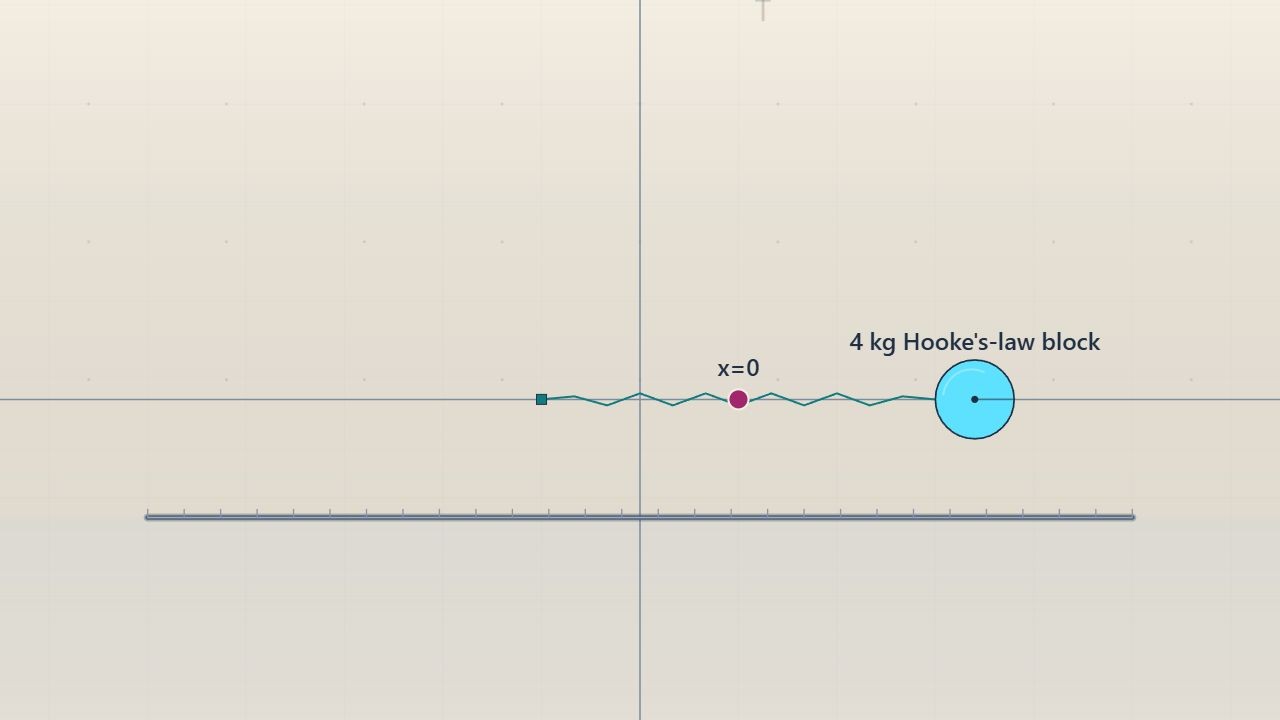
Hooke’s Law and Elastic Potential Energy guided lesson preview Start guided lesson
Explore the model. Make predictions. Check your thinking.

Learn by doing

Three ideas you’ll put into motion

Test the restoring force

Compare spring forces for different displacements from equilibrium.

Connect displacement and energy

Observe how spring potential energy changes when displacement changes.

Predict a spring-driven motion

Use an energy model to connect a spring’s stored energy with an object’s motion.

The big idea

The key ideas, at a glance.

The force points back

Within the linear spring model, Fs = −kx. The minus sign indicates a restoring force toward equilibrium.

Energy depends on displacement squared

Elastic potential energy is Us = ½kx2. Equal stretch and compression magnitudes store equal energy in the ideal model.

A quick comparison

Double a spring’s displacement magnitude while keeping k fixed.

Force magnitude doublesStored energy quadruples

restoring forcedisplacement x
Teaching this topic?Classroom fit, AP connections, and support
Classroom fit
Use for a concept introduction, guided independent practice, or a projected class discussion.
Before students begin
Force directions, work, kinetic energy, and conservation of mechanical energy.
Built-in support
Prepared scenes, guided prompts, and feedback on lesson questions.
AP Physics 1 connections
Unit 3: elastic potential energy, spring forces, and energy transfer.
Check for understanding
Ask why doubling spring displacement does not merely double its stored energy.
Optional extension
Investigate the Spring Launch Up a Curved Ramp lab.
Meet the educator behind Build Physics

Ready to test your thinking?

The first scene is set up. Start the lesson and explore.

Start lesson