Choose each body and its axis
Write Newton’s second law for each moving mass, then take moments about the pulley axle or rod pin. Forces through the chosen axis can have zero torque while still appearing in force equations.
 BuildPhysics
AP Physics 1 · Unit 5 · Rotation
Connect force equations for translating objects to torque equations for rotating ones. Compare unequal tensions in an Atwood machine, a falling rod’s initial accelerations, a rope-driven disk, a cart and hanging load, and a spool unwinding from a fixed string.
12 questions6 conceptual · 6 calculation
Start practiceFree · No account required · Self-paced
 Open interactive practice
What you’ll practice
Write Newton’s second law for each moving mass, then take moments about the pulley axle or rod pin. Forces through the chosen axis can have zero torque while still appearing in force equations.
Apply a = Rα and v = Rω only when the cord does not slip. Compare the tangential accelerations of a rod’s center and end without assuming they equal g.
Include pulley inertia in the acceleration denominator, calculate each side’s tension, and find a pulley mass that produces a target acceleration.
A question from this set
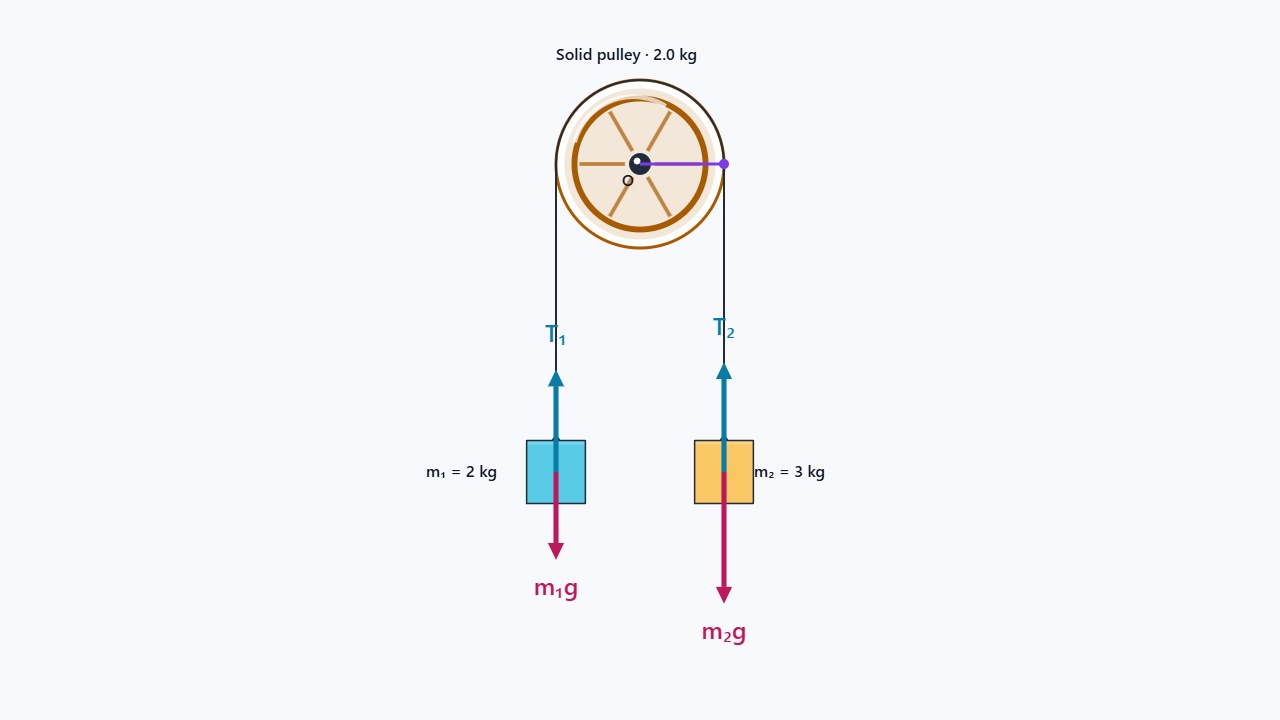
An Atwood machine has a lighter mass on the left and a heavier mass on the right. A light cord turns a massive pulley without slipping, and the heavier mass accelerates down. How do the two cord tensions compare?
Try it in the practice setKey ideas
For an accelerating pulley with equal rim radii, the difference between the two tensions supplies its net torque. Equal tensions are the negligible-inertia limit, not a universal property of a light cord.
A spool can accelerate downward while unwinding from a string fixed at its upper end. Its weight and tension determine translation, while the off-center tension determines rotation about its center.
See the physics
After attempting the questions, inspect the measured side tensions, linear acceleration, pulley rotation, and no-slip travel graphs. Compare pulley radii and inertia, watch a rod fall under its own weight, and record a spool crossing its descent marker.
Use a hint for a starting point or open a worked solution to follow the reasoning. Your progress saves in this browser, so you can return to unfinished questions.
Begin with a conceptual question, then work through the calculations.