Analyze two kinds of motion
Choose an object, draw its forces, and distinguish center-of-mass acceleration from angular acceleration.
 BuildPhysics
AP Physics 1 · Unit 5 · Torque and Rotational Dynamics
Watch a spool unwind and a massive pulley turn, then connect separate force and torque equations through the string’s no-slip constraint.
Start lesson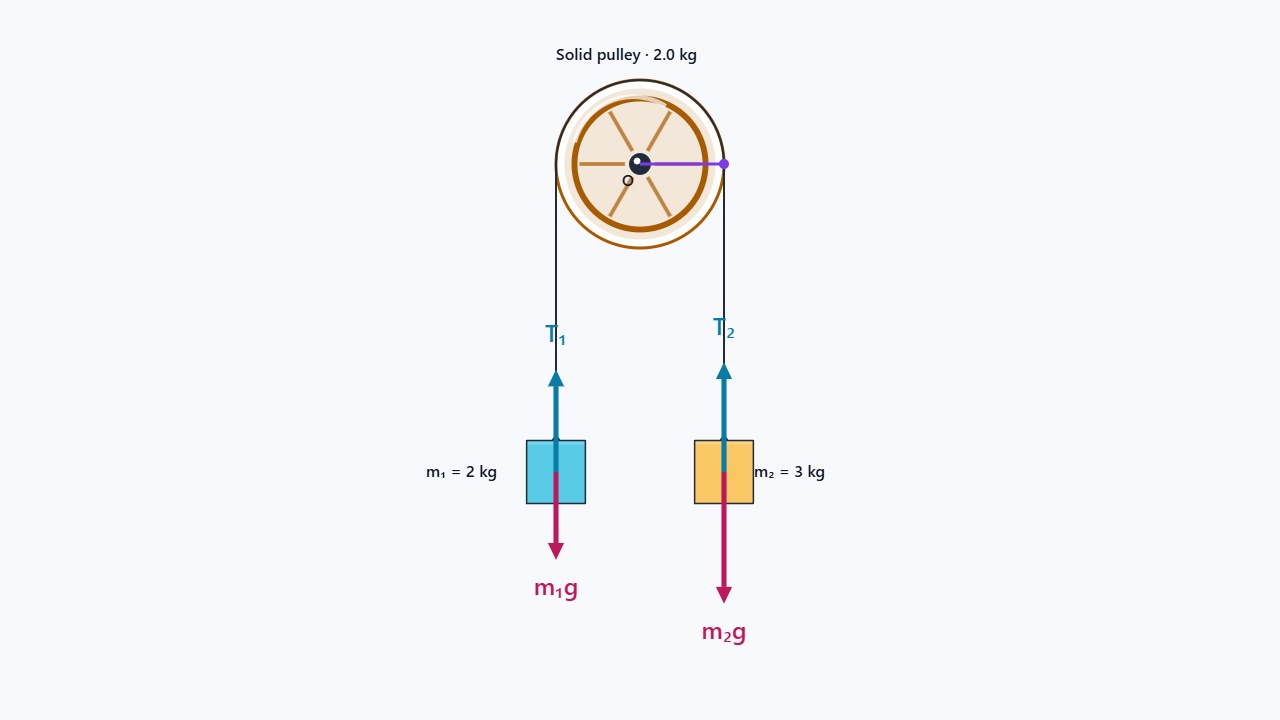 Start guided lesson
Learn by doing
Choose an object, draw its forces, and distinguish center-of-mass acceleration from angular acceleration.
Use the no-slip string relationship with Newton’s laws to predict the motion of an unwinding spool and an Atwood machine.
Compare mass, radius and inertia effects, then choose a pulley mass for a target acceleration.
The big idea
Net force determines center-of-mass acceleration; net torque determines angular acceleration. For a string that unwinds without slipping, the linear and angular accelerations are connected by a = Rα.
The two rim tensions supply opposing torques about the axle. Their difference changes the pulley’s rotation, so equal tensions are a special limiting case rather than a rule for every string-and-pulley system.
A quick comparison
Increase the mass of a solid pulley while keeping its radius and both hanging masses fixed.
The shared acceleration decreases because more rotational inertia must be accelerated.
The first scene is set up. Start the lesson and explore.