Choose the correct axis and inertia
Use perpendicular distance for point masses. Combine a disk and radial rods, distinguish a hoop from a solid cylinder, and shift a rod’s axle with the parallel-axis theorem.
 BuildPhysics
AP Physics 1 · Unit 5 · Rotation
See how the axis and mass distribution determine rotational inertia. Calculate the inertia of a rectangular package frame, infer a polishing wheel’s mass, size a fan motor, analyze tethered flight, and compare bicycle sprockets.
12 questions6 conceptual · 6 calculation
Start practiceFree · No account required · Self-paced
 Open interactive practice
What you’ll practice
Use perpendicular distance for point masses. Combine a disk and radial rods, distinguish a hoop from a solid cylinder, and shift a rod’s axle with the parallel-axis theorem.
Calculate tangential thrust and chain-drive torque. Keep motor torque, brake torque, and net torque separate before applying Στ = Iα.
Use angular acceleration to find final angular speed and tangential acceleration. Distinguish the inward acceleration of circular motion from the component that changes speed.
A question from this set
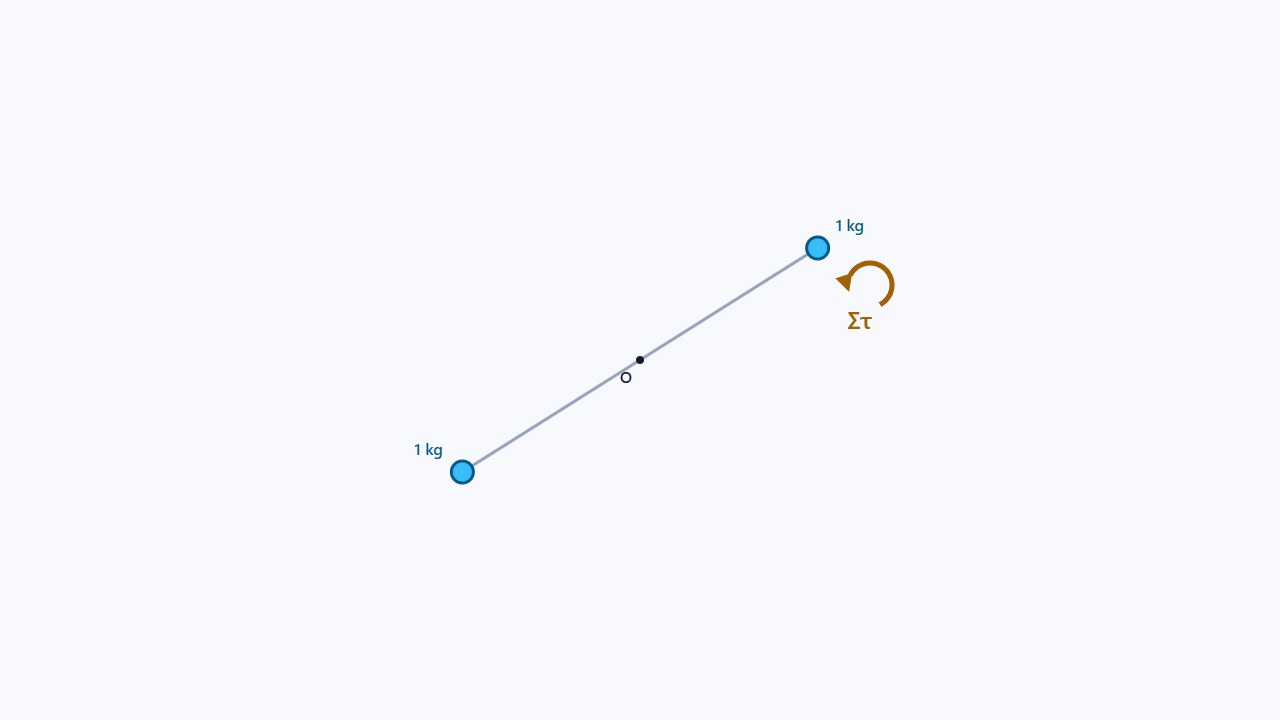
Two equal point masses are fixed to light spokes on opposite sides of an axle. Each distance from the axle is doubled while the same net torque is applied. How does their angular acceleration change?
Try it in the practice setKey ideas
A point mass contributes mr² using the shortest distance to the chosen axis. Moving masses outward can change rotational inertia much more than the same factor changes their distances.
A motor accelerating a rotor against bearing resistance supplies more torque than Iα alone. At steady angular velocity, nonzero driving and resisting torques can balance.
See the physics
After attempting a question, run the native force-driven models and compare torque, rotational inertia, and the slope of angular velocity. Switch mass placements, disk and hoop shapes, bearing resistance, axes, or sprockets. The tethered drone uses a taut string and tangent-following thrust.
Use a hint for a starting point or open a worked solution to follow the reasoning. Your progress saves in this browser, so you can return to unfinished questions.
Begin with a conceptual question, then work through the calculations.