Find period, length, and local gravity
Use the small-angle pendulum model to estimate a tower height, choose lengths for different worlds, or infer gravity from timed full oscillations. Keep pivot-to-center length distinct from floor clearance.
 BuildPhysics
AP Physics 1 · Unit 7 · Oscillations
Use swing timing, gravity, and energy to explain pendulums and compare them with spring oscillators.
12 questions6 conceptual · 6 calculation
Start practiceFree · No account required · Self-paced
 Open interactive practice
What you’ll practice
Use the small-angle pendulum model to estimate a tower height, choose lengths for different worlds, or infer gravity from timed full oscillations. Keep pivot-to-center length distinct from floor clearance.
Calculate speed from gravitational energy, separate zero tangential acceleration from nonzero inward acceleration, and use the radial force balance to find string tension.
Predict the effects of changing mass, length, release angle, and gravity. Contrast gravity-dependent pendulum timing with spring timing and account for energy in a cord-and-spring comparison.
A question from this set
Two ideal simple pendulums have the same pivot-to-bob-center length and the same small release angle. One bob has four times the mass of the other. How do their periods compare?
Try it in the practice setKey ideas
The familiar pendulum period assumes a small release angle. A larger-angle swing takes longer at the same length; inserting that period into the small-angle inverse formula overestimates the length. A different bob mass does not explain the shift.
The tangential component of gravity vanishes at the lowest point, but the bob is moving along a curved path. Tension exceeds weight so their difference provides the inward force needed to change the velocity direction.
See the physics
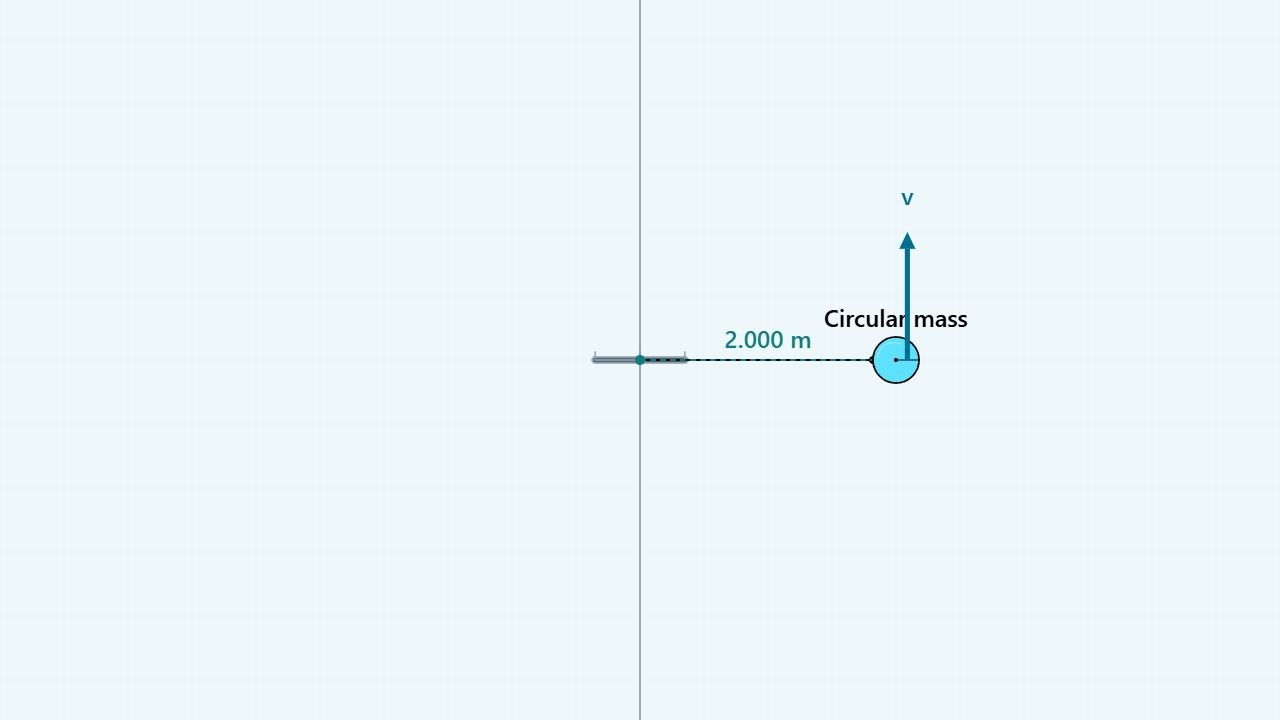
After attempting the questions, run native string-and-bob swings under the stated gravity. Record full periods between same-direction crossings or pause at the first bottom crossing to inspect force and acceleration. The worksheet’s spring comparisons use actual attached springs, a cord, and a fixed pulley.
Use a hint for a starting point or open a worked solution to follow the reasoning. Your progress saves in this browser, so you can return to unfinished questions.
Begin with a conceptual question, then work through the calculations.