BuildPhysics

AP Physics 1 · Unit 2, Part 2 · Circular Motion and Gravity

Circular Motion

Observe a circular trip and test how speed, radius, and mass change the acceleration and inward force needed to keep turning.

Start lesson
  • Free
  • No account required
  • Self-paced
Circular Motion guided lesson preview Start guided lesson
Explore the model. Make predictions. Check your thinking.

Learn by doing

Three ideas you’ll put into motion

Measure the motion

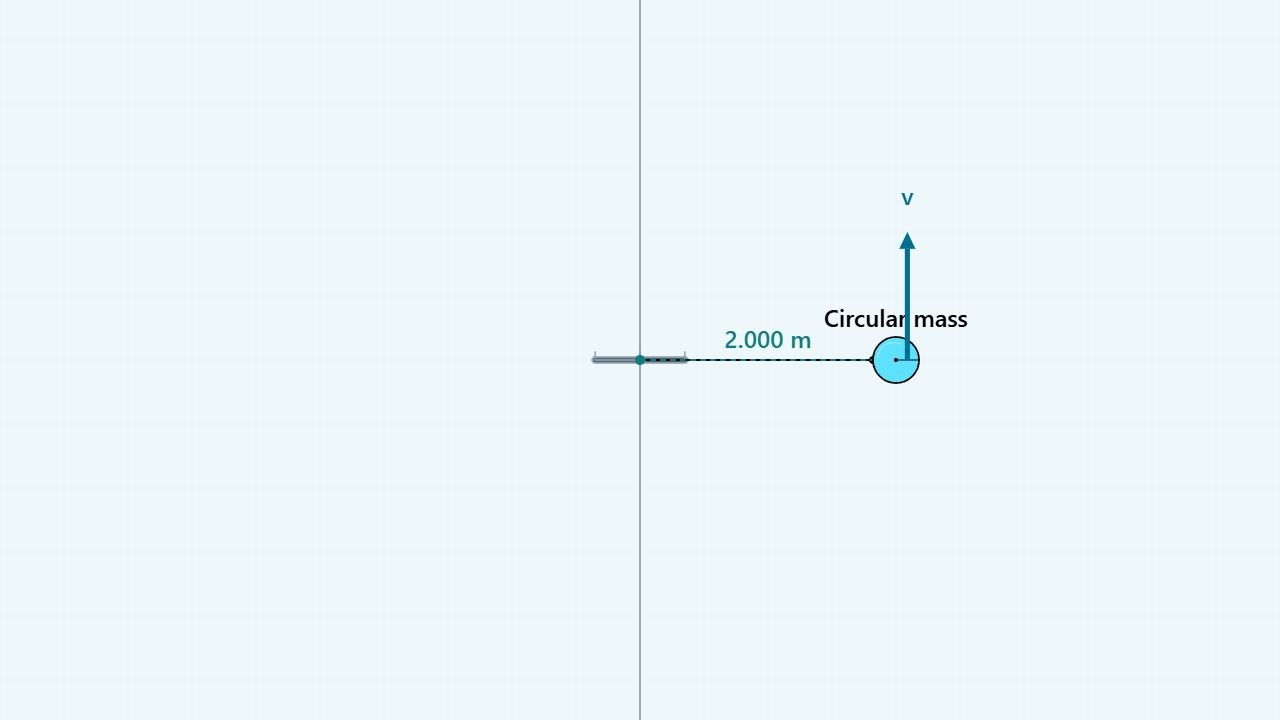
Connect radius and period with the speed around a circular path.

Track the directions

Compare the tangent velocity with the inward acceleration.

Change one variable

Test how speed, radius, or mass changes the required inward force.

The big idea

The key ideas, at a glance.

Turning changes velocity

Even at constant speed, changing direction requires an acceleration toward the center: ar = v2/r.

Centripetal describes the net force

The inward net force is mv2/r. It comes from real interactions, such as tension, gravity, or contact forces.

A quick comparison

Double the speed while keeping radius and mass fixed.

Required inward force becomes four times as large.

velocity: tangentnet force: inward
Teaching this topic?Classroom fit, AP connections, and support
Classroom fit
Use for a concept introduction, guided independent practice, or a projected class discussion.
Before students begin
Velocity vectors, Newton’s second law, and the circumference of a circle.
Built-in support
Prepared scenes, guided prompts, and feedback on lesson questions.
AP Physics 1 connections
Unit 2: circular motion, radial acceleration, and net force.
Check for understanding
Ask why constant speed does not guarantee zero acceleration.
Optional extension
Compare more trials in the Uniform Circular Motion lab.
Meet the educator behind Build Physics

Ready to test your thinking?

The first scene is set up. Start the lesson and explore.

Start lesson