Calculate pressure from a perpendicular load
Compare the same block resting on different faces and share a chair’s load across circular feet. Match the force carried by one contact to that contact’s area.
 BuildPhysics
AP Physics 1 · Unit 8 · Fluids
Connect contact area and liquid depth to pressure, then use pressure differences to predict net forces.
12 questions6 conceptual · 6 calculation
Start practiceFree · No account required · Self-paced
 Open interactive practice
What you’ll practice
Compare the same block resting on different faces and share a chair’s load across circular feet. Match the force carried by one contact to that contact’s area.
Subtract a container’s empty mass before using equal fill volumes to find an unknown density. Measure a cork’s depth below its own water surface and compare containers of different widths.
Use outside minus inside absolute pressure across a vacuum opening or submerged suction cup. Add the separate oil and water contributions to find bottom gauge and absolute pressure.
A question from this set
A uniform rectangular block has edge lengths 3.00 cm, 4.00 cm, and 6.00 cm. Face A is 4.00 cm × 6.00 cm, face B is 3.00 cm × 4.00 cm, and face C is 3.00 cm × 6.00 cm. Rank the pressure the same block exerts on a table when resting on each face, greatest first.
Try it in the practice setKey ideas
A stationary liquid exerts force perpendicular to a contacted surface. Equal-depth patches have equal pressure even when one is on a horizontal bottom and the other is on a vertical wall.
Absolute pressure is measured from vacuum. Gauge pressure subtracts the surrounding atmosphere, so a chamber below atmospheric pressure has a negative gauge reading while its absolute pressure remains nonnegative.
See the physics
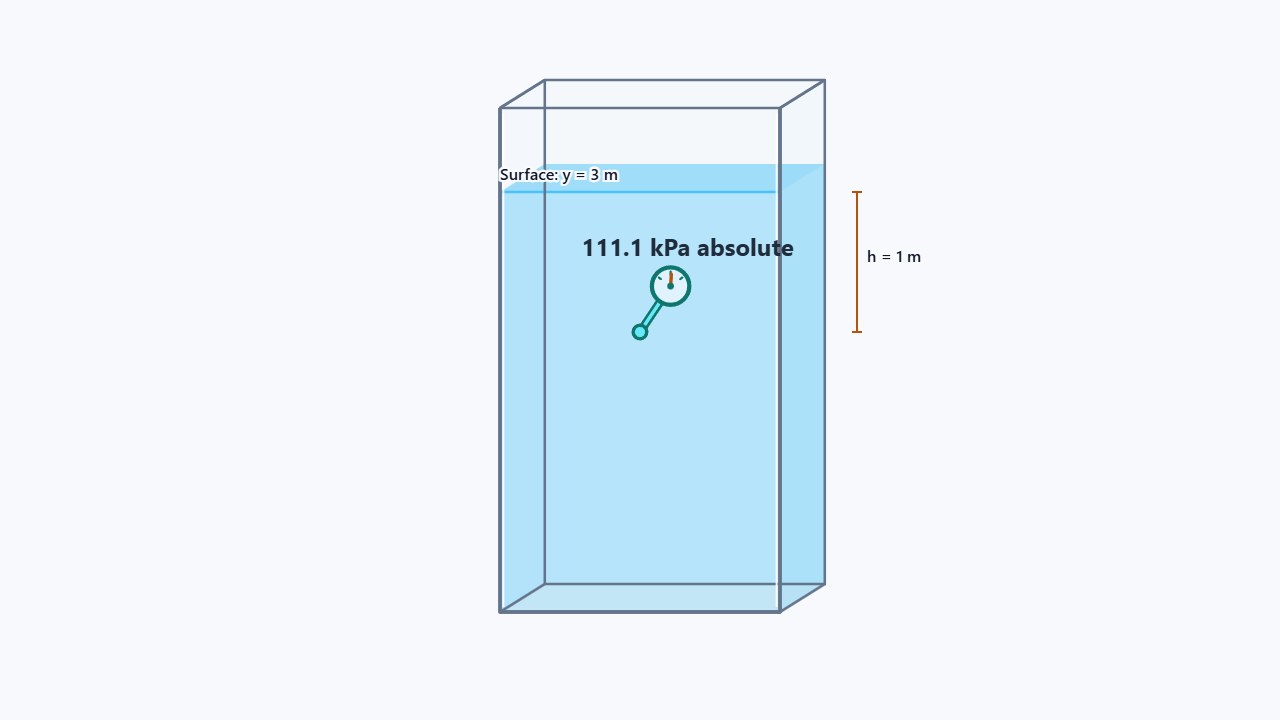
After an answer attempt, run gravity-driven floor contacts, fill equal-volume calibration containers, or scan a pressure probe through stationary water and oil. Compare alternate contact areas, extra chair feet, wider containers, deeper cups, and thicker oil layers. Recorded graphs and readouts reveal the measured quantities.
Use a hint for a starting point or open a worked solution to follow the reasoning. Your progress saves in this browser, so you can return to unfinished questions.
Begin with a conceptual question, then work through the calculations.