BuildPhysics

AP Physics 1 · Unit 8 · Fluids

Pressure

Change force and area, measure pressure with depth, and connect atmospheric, absolute and gauge pressure using a movable sensor.

Start lesson
  • Free
  • No account required
  • Self-paced
Pressure guided lesson preview Start guided lesson
Lower a pressure probe through oil and water, then compare the measurements with a layered-liquid model.

Learn by doing

Three ideas you’ll put into motion

Compare force and area

Change one property at a time and use perpendicular force per area to explain contact pressure.

Measure pressure with depth

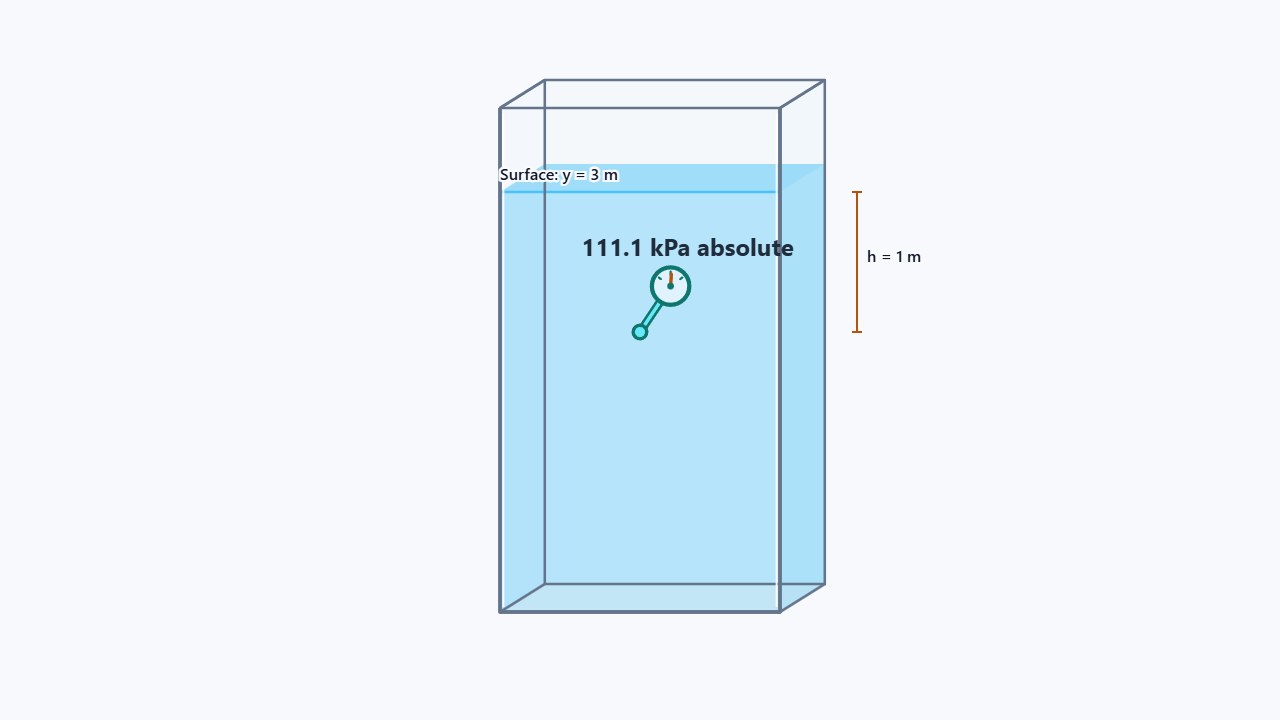
Move a sensor through liquids, read pressure–depth graphs and develop the hydrostatic model from force balance.

Choose a pressure reference

Distinguish absolute and gauge pressure, investigate a vacuum seal and add contributions through oil and water.

The big idea

The key ideas, at a glance.

Pressure is force per area

Pressure is a scalar: P = F⊥/A. Forces act perpendicular to a surface; equal loads produce greater pressure on smaller areas.

Start from a reference pressure

In a stationary uniform liquid, P = Psurface + ρgh. Gauge pressure subtracts atmospheric pressure. Through layered liquids, add ρgh for each layer above the sensor.

A quick comparison

Keep the perpendicular force fixed while doubling its contact area.

The average pressure becomes half as large.

same forcetwice the areaPressure is perpendicular force divided by area
Teaching this topic?Classroom fit, AP connections, and support
Classroom fit
Use for a concept introduction, guided independent practice, or a projected class discussion.
Before students begin
Density, force, weight, area, basic algebra and graph slope. The lesson introduces pressure and its reference scales.
Built-in support
Prepared scenes, guided prompts, and feedback on lesson questions.
AP Physics 1 connections
Unit 8, Topic 8.2: pressure. Relate pressure to perpendicular force per area, microscopic interactions, depth and density, and distinguish absolute and gauge pressure.
Check for understanding
Ask why equal depths in the same stationary liquid have equal pressure, why a vacuum can have negative gauge pressure, and where a layered-liquid pressure graph changes slope.
Meet the educator behind Build Physics

Ready to test your thinking?

The first scene is set up. Start the lesson and explore.

Start lesson