Separate pressure, volume, and bottom force
Compare equal-depth tanks with different widths and shapes. Explain why equal pressure does not imply equal liquid volumes or equal bottom forces, and account for vertical forces from sloping walls.
 BuildPhysics
AP Physics 1 · Unit 8 · Fluids
Follow pressure through connected liquids, interpret column heights, and use hydraulic pressure to find braking torque.
12 questions6 conceptual · 6 calculation
Start practiceFree · No account required · Self-paced
 Open interactive practice
What you’ll practice
Compare equal-depth tanks with different widths and shapes. Explain why equal pressure does not imply equal liquid volumes or equal bottom forces, and account for vertical forces from sloping walls.
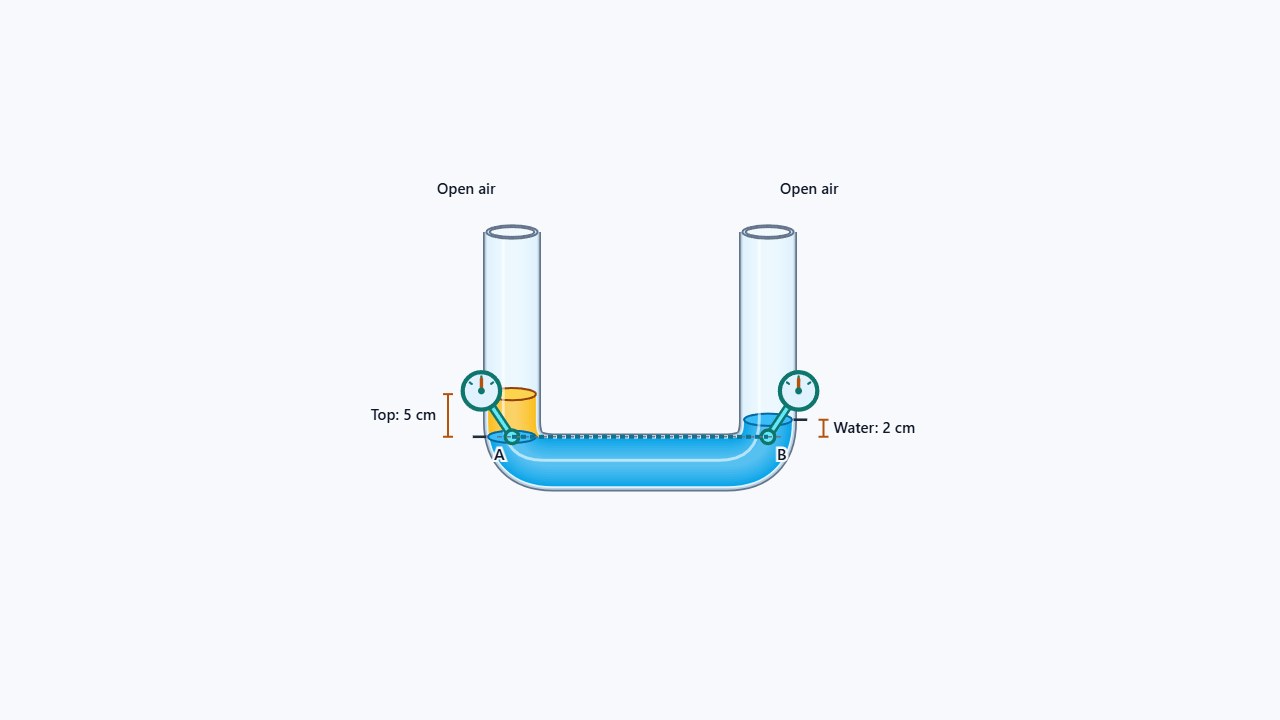
Choose a shared level in the same liquid, track pressure increases downward and decreases upward, infer an unknown density, and solve a three-liquid differential manometer whose unknown level also changes an upper column.
Compare a perfect-vacuum barometer with a nonzero vapor-pressure boundary. Transmit gauge pressure between pistons, find a shoe’s friction force, and calculate its braking torque about a drum axle.
A question from this set
Three open containers hold water to the same depth. A is a straight-sided tank, B is a narrower tank, and C widens toward the top. Their bottom elevations are equal. Which statement correctly separates pressure from volume?
Try it in the practice setKey ideas
A horizontal comparison through one stationary connected liquid gives equal pressure. Different liquid layers can have different densities and pressure gradients; their interface still has one continuous pressure.
The high-pressure gas depresses its own liquid surface. Use the vertical separation of the free surfaces, then add the atmospheric reference only when an absolute pressure is requested.
See the physics
After attempting a question, scan equal-level probes through connected liquids, compare both pressure routes in a differential manometer, or measure a barometer column. The hydraulic comparison uses the transmitted pressure to apply a tangential braking force to a rotating drum.
Use a hint for a starting point or open a worked solution to follow the reasoning. Your progress saves in this browser, so you can return to unfinished questions.
Begin with a conceptual question, then work through the calculations.