Use the rope constraint
Relate the displacements and acceleration magnitudes of connected loads. Choose consistent positive directions along their motion.
 BuildPhysics
AP Physics 1 · Unit 2, Part 1 · Forces
Connect force equations for objects joined by a rope. Practice Atwood machines, a cart pulled by a hanging load, friction, unknown masses, and a three-load extension.
12 questions6 conceptual · 6 calculation
Start practiceFree · No account required · Self-paced
 Open interactive practice
What you’ll practice
Relate the displacements and acceleration magnitudes of connected loads. Choose consistent positive directions along their motion.
Add the force equations to find system acceleration, then isolate one object to solve for tension or an unknown mass.
Compare vertical Atwood systems with a cart and hanging load. Include rough-table friction, an angled winch force, and a third connected load.
A question from this set
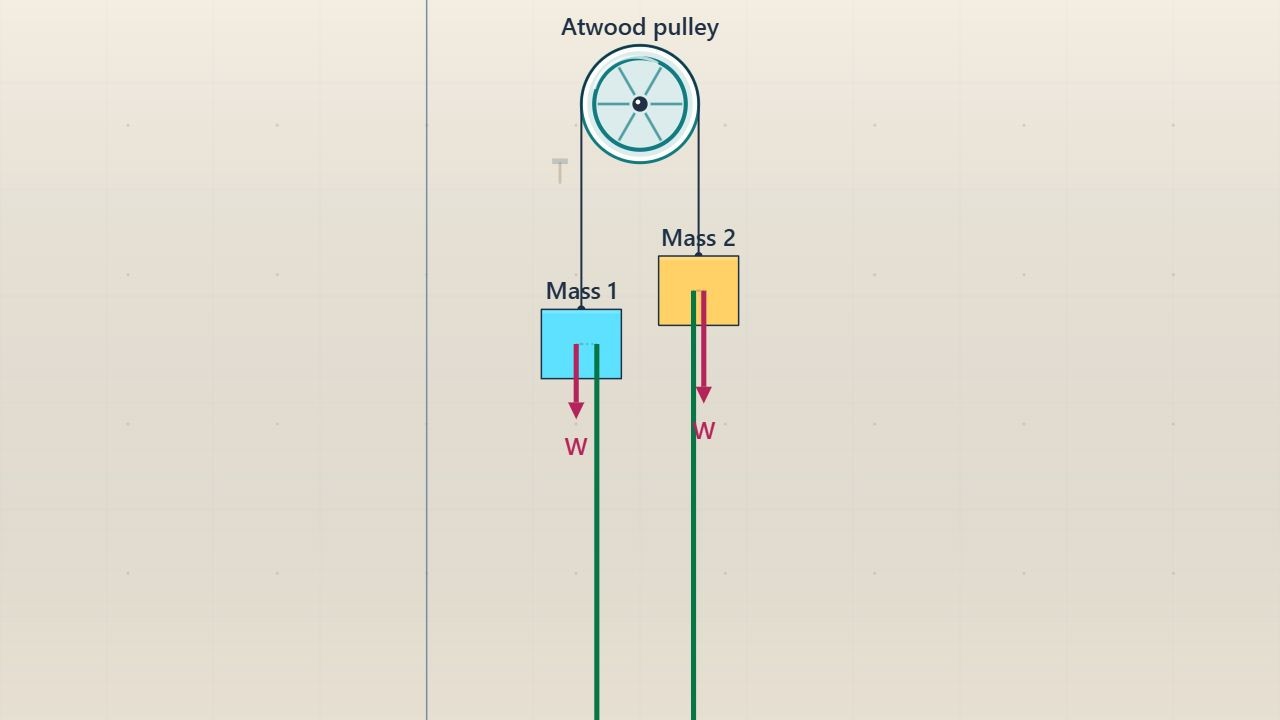
Two unequal loads hang from opposite ends of a taut, light rope over an ideal fixed pulley. When released, how do their acceleration magnitudes compare?
Try it in the practice setKey ideas
For the ideal fixed-pulley setups, the two ends move equal distances in equal time. They can accelerate in opposite directions with the same magnitude.
When both connected objects are included, the rope’s internal forces cancel in the combined equation. A separate equation for either object still includes tension.
See the physics
Check your equations, then compare both objects’ changing velocities and travel distances. Reveal the tension after running and compare it with the weight and acceleration you used.
Use a hint for a starting point or open a worked solution to follow the reasoning. Your progress saves in this browser, so you can return to unfinished questions.
Begin with a conceptual question, then work through the calculations.