Track connected motion
Observe how the rope constrains the two objects’ acceleration magnitudes.
 BuildPhysics
AP Physics 1 · Unit 2, Part 1 · Forces
Connect two masses, compare their shared motion, and choose object or system equations to predict tension and acceleration.
Start lesson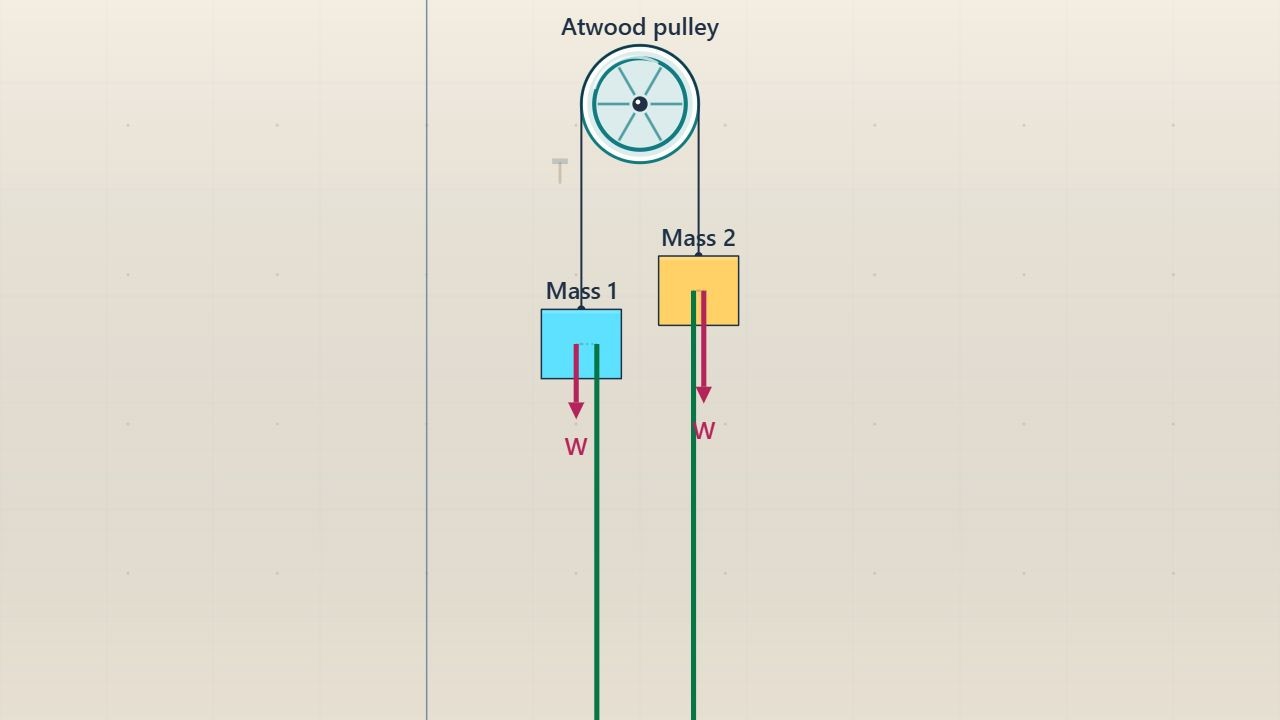 Start guided lesson
Learn by doing
Observe how the rope constrains the two objects’ acceleration magnitudes.
Compare separate force diagrams with a combined-system model.
Predict how changing the connected masses affects acceleration, then check the motion.
The big idea
For an ideal taut, inextensible rope over a fixed pulley, the connected masses share an acceleration magnitude. Choose each direction consistently.
Tension appears in each object’s equation. For the two-mass system, internal tension cancels when combining the equations appropriately.
A quick comparison
In an ideal hanging-mass system, the heavier side accelerates downward.
The other side accelerates upward with the same magnitude.
The first scene is set up. Start the lesson and explore.