Interpret apparent weight
Identify the normal force measured by a scale. Compare rest and constant velocity with upward or downward acceleration.
 BuildPhysics
AP Physics 1 · Unit 2, Part 1 · Forces
Connect scale readings and rope tension to elevator acceleration. Analyze upward and downward trips, braking, free fall, contact loss, and several masses supported inside a moving lift.
12 questions6 conceptual · 6 calculation
Start practiceFree · No account required · Self-paced
 Open interactive practice
What you’ll practice
Identify the normal force measured by a scale. Compare rest and constant velocity with upward or downward acceleration.
Work out what happens when a rising elevator slows or a descending elevator brakes. Separate the direction of travel from the velocity change.
Solve for normal force, tension, or acceleration in a rider, case, basket, or elevator car. Examine contact between stacked masses and the limit where support ends.
A question from this set
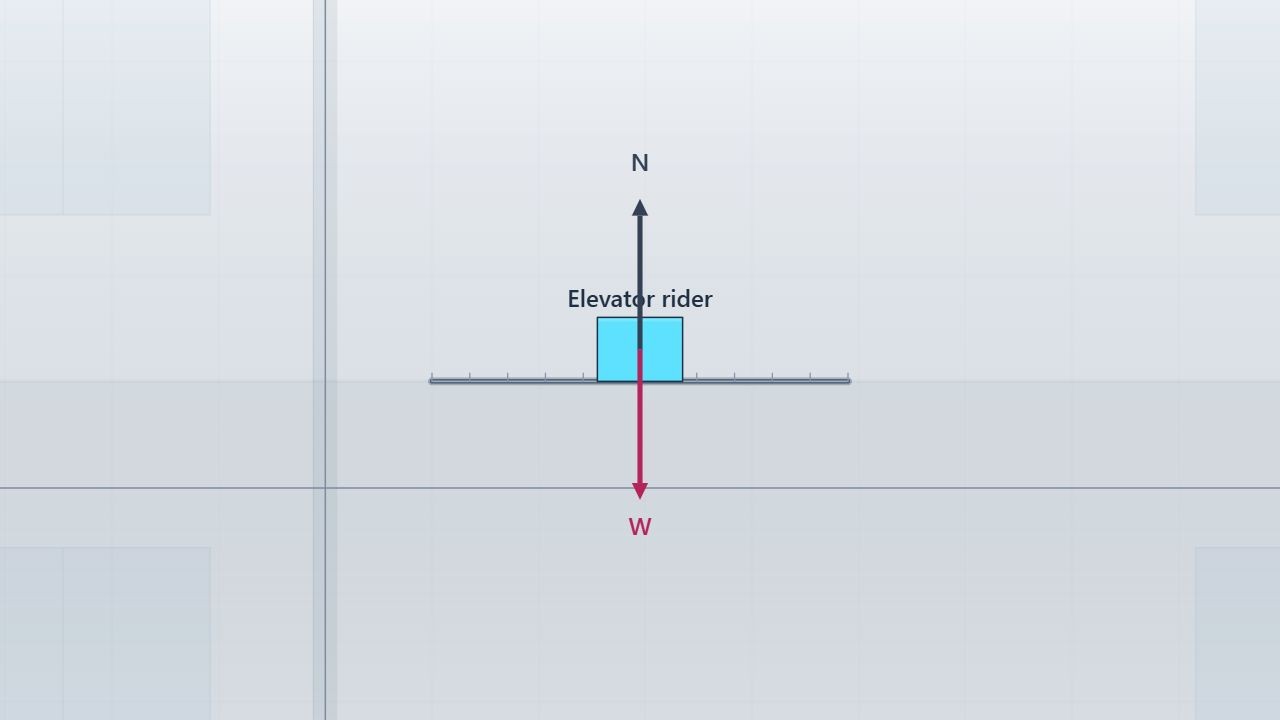
A rider stands on a force scale in an elevator moving upward at constant velocity. Which force is the scale reading?
Try it in the practice setKey ideas
A scale measures the support force on the rider. Gravitational force remains mg near Earth, while the support force can change with acceleration.
With upward positive, N − mg = ma for a rider supported by the floor. Apply a separate force equation to the whole car when finding cable tension.
See the physics
After checking your response, follow the elevator and rider together. Compare normal force and weight, inspect cable tension, and use the free-fall or contact-loss trials to test the support limit.
Use a hint for a starting point or open a worked solution to follow the reasoning. Your progress saves in this browser, so you can return to unfinished questions.
Begin with a conceptual question, then work through the calculations.