Write local radial force equations
Compare tension or support with weight at the bottom, top, and side of a curved path.
 BuildPhysics
AP Physics 1 · Unit 2, Part 2 · Circular Motion and Gravity
Analyze a swing, an inside loop, a rounded hill, and an upright Ferris-wheel cabin. Use the speed given at each point to find support forces and accelerations.
12 questions6 conceptual · 6 calculation
Start practiceFree · No account required · Self-paced
 Open interactive practice
What you’ll practice
Compare tension or support with weight at the bottom, top, and side of a curved path.
Find a limiting speed from zero tension or zero normal force. Recognize when a rope goes slack or a body leaves a surface.
Resolve weight at an angled swing and distinguish radial acceleration from total acceleration. Compare cabin contact forces around a Ferris wheel.
A question from this set
A rider passes the lowest point of a taut-rope swing with nonzero speed. How does rope tension compare with the rider’s weight at that instant?
Try it in the practice setKey ideas
At the bottom, inward is upward; at the top of an inside loop, it is downward. Choose that direction before adding the force components.
Weight can remain nonzero when tension or normal force falls to zero. Beyond that boundary, the assumed contact or taut-rope path may fail.
See the physics
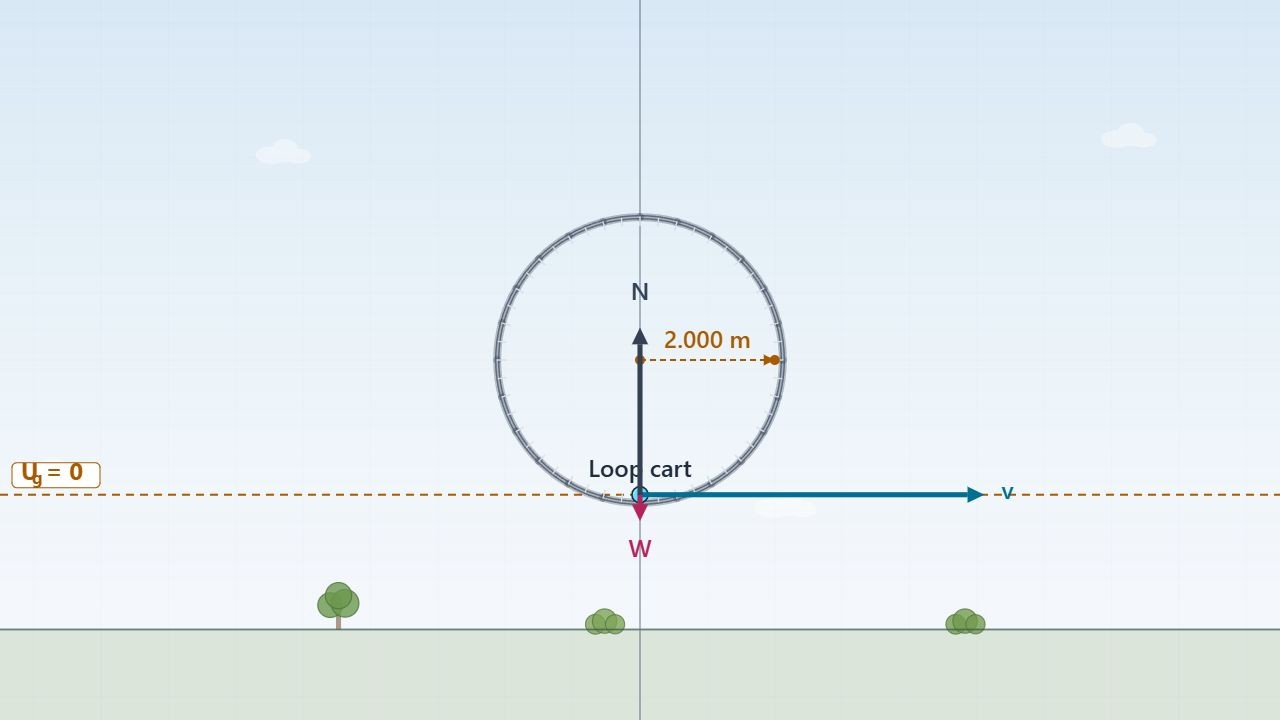
After attempting a question, run the prepared swing, loop, crest, or cabin scene. Compare support forces and motion at the specified location, then examine the available contact-boundary variants.
Use a hint for a starting point or open a worked solution to follow the reasoning. Your progress saves in this browser, so you can return to unfinished questions.
Begin with a conceptual question, then work through the calculations.