BuildPhysics

AP Physics 1 · Unit 2, Part 2 · Circular Motion and Gravity

Vertical Circular Motion

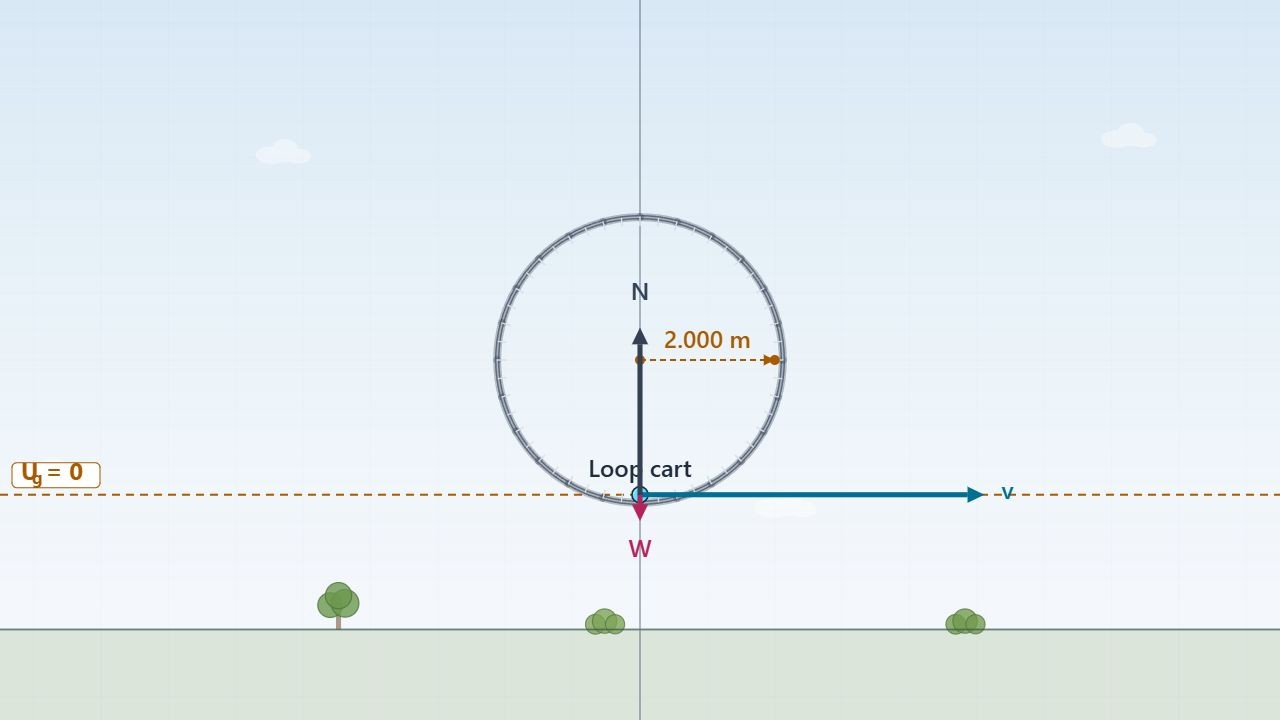
Follow an object around a vertical loop and compare speed, contact force, and acceleration at the bottom, side, and top.

Start lesson
  • Free
  • No account required
  • Self-paced
Vertical Circular Motion guided lesson preview Start guided lesson
Explore the model. Make predictions. Check your thinking.

Learn by doing

Three ideas you’ll put into motion

Follow the loop

Observe how height, speed, and force directions change around the track.

Build the radial equation

Use the actual forces and choose inward separately at each position.

Test continued contact

Change the entry conditions and investigate when the object leaves the inside track.

The big idea

The key ideas, at a glance.

Inward changes direction

At the top of an inside loop, both gravity and the normal force can point inward. At the bottom, they oppose one another.

Reaching the top is not enough

Continued contact requires a nonnegative normal force. At the top contact limit, N = 0 and v2 = gr.

A quick comparison

Consider the top of an inside loop at the contact limit.

Gravity supplies all the inward force.

at the bottomat the topChoose inward before adding radial forces
Teaching this topic?Classroom fit, AP connections, and support
Classroom fit
Use for a concept introduction, guided independent practice, or a projected class discussion.
Before students begin
Circular motion, force diagrams, and conservation of mechanical energy for a frictionless track.
Built-in support
Prepared scenes, guided prompts, and feedback on lesson questions.
AP Physics 1 connections
Unit 2 circular dynamics, with Unit 3 energy connections.
Check for understanding
Ask why zero normal force at the top does not mean zero acceleration.
Optional extension
Explore the Vertical Circular Motion lab.
Meet the educator behind Build Physics

Ready to test your thinking?

The first scene is set up. Start the lesson and explore.

Start lesson